Tilda Publishing

MATERIAL PROPERTIES OF MODERN FIBER ROPES

PART I: THE CONCEPT, CLASSIFICATION, AND STRUCTURE OF SYNTHETIC POLYMERS. CHARACTERISTICS OF DENSITY, STRENGTH, AND ELASTICITY

Material Properties of Modern Synthetic Fiber Ropes
Source: blackdiamondequipment.com
Last Update: 16.01.2026
Keep in mind that the relevance of information might change over time.

Introduction

Ropes come in many varieties. They differ in length, diameter, and color. These differences are so obvious that they hardly require explanation. The real complexity arises when two ropes that appear identical at first glance possess completely different properties — properties that are difficult to assess by sight or touch. For example, one rope with a 10 mm diameter may break under a load of 20 kN, while another can withstand 50 kN while weighing half as much.

At first glance, the lighter, stronger rope seems like the obvious choice for a climber. Unfortunately, it’s not that simple. While both ropes can arrest a fall, the impact force generated during that fall may exceed what the human body can safely tolerate. As a result, the climber’s primary concern is no longer the rope’s breaking strength but its ability to stretch and dissipate energy. Ideally, a climbing rope should also resist abrasion, repel water, remain soft and easy to handle, and meet many other practical requirements.

The demands placed on ropes are virtually limitless. Depending on the field of application, these requirements may differ substantially or even be diametrically opposed. In climbing, as we have seen, elastic ropes are essential, whereas in sailing, ropes with minimal elongation are preferred. In mountaineering, an optimal balance between strength and low mass is required, while in work at height and arboriculture, weight is often of secondary importance, but strength is never compromised. And what is the most important property for firefighters? Correct — heat resistance. This is why ropes and cords vary so widely.

All these differences ultimately depend on two main factors:
  1. The rope’s construction and;
  2. The materials used in its manufacture.

The influence of the first factor was discussed in the Climbing Rope Manufacturing article, where we briefly examined how ropes built according to one of the most widely used designs — the kernmantle* — differ from one another.

*Kernmantle (from German: kern — “core” and mantle — “sheath”) is a rope construction with a load-bearing inner core and a protective outer sheath.


In this article, we focus on the types and characteristics of the main synthetic materials used in modern rope production. By synthetic, we mean materials that do not occur in nature but are created by humans through specialized petrochemical processes. Natural fibers such as hemp, jute, cotton, flax, or sisal are not discussed here, as they are rarely used in the extreme activities considered.
Natural and synthetic materials used in rope manufacturing, arranged in order of increasing strength.
Left to right: materials used in rope manufacturing, arranged in order of increasing strength. Natural materials are highlighted in green; synthetic materials in blue.
Source: rope.com
It is worth remembering that fiber ropes are just one example of a much broader class of textile products.* As textile products, they are made from materials that are generally highly versatile. For this reason, polyamide, polyester, high-modulus polyethylene, various aramids, and other materials discussed in this article are widely used not only in ropes but also in a broad range of equipment — from clothing, backpacks, and tents to harnesses, slackline webbings, and paragliding canopies.

To justify this wide range of applications and allow meaningful comparisons between materials, this article series will begin with a brief overview of textile material classification and properties, continue with a detailed analysis of each material and its specific characteristics, and conclude with a comprehensive summary table. I hope this will prove useful to more than just rope enthusiasts.

*Textiles: soft, flexible materials, including fibers, yarns, filaments, threads, and fabrics, as well as products made from them.

Concept, Classification, and Structure of Synthetic Polymers Used in Rope Production

We already know that textile materials (fibers) are classified by origin into natural* and man-made**. From a molecular point of view, both types are polymers — that is, substances composed of many repeating structural units (monomers) linked together in long chains. Examples of natural polymers include skin, wool, cotton, various proteins, and even DNA. Polyamide, polyester, polyethylene, and polypropylene are synthetic polymers, from which most modern ropes and many other products are made.
*Natural fibers are fibers that form in nature without human intervention. They arise either biologically (plant or animal origin) or as a result of geological processes (mineral origin).

**Man-Made Fibers Include:
  • Regenerated fibers — produced from natural polymers (e.g., cellulose) that are subsequently chemically processed.
  • Synthetic fibers — made from synthesized, petroleum-based polymers.
  • Inorganic fibers — produced from glass, carbon, metals, or ceramics (e.g., carbon and basalt fibers, as well as fiberglass).

Molecular model of polyethylene terephthalate (PET)
Molecular model of polyethylene terephthalate (PET) — a polymer belonging to the polyester class (PES), from which polyester fibers and corresponding ropes are produced.
Chemical formula: (C₁₀H₈O₄)ₙ
Source: wikipedia.org
It is important to understand that polyamide, polyester, and many other familiar names do not denote a single material, but rather entire classes of materials, encompassing multiple types, grades, and trade names. For example, within the polyamide class, rope applications most commonly use grades such as Nylon 6 and Nylon 66. These two differ in physical and chemical properties that, while not radically different, are nonetheless distinct. Regrettably, such nuances are often omitted in general-purpose articles and manufacturer catalogs. This complicates the comparison of ropes and other end products and makes it difficult to identify the true causes of differences between them.

List of Synthetic Materials (Polymers) and Corresponding Trade Names Used in the Production of Modern Fiber Ropes


CLASS


TYPE


REPRESENTATIVES


ABBREVIATION


TRADE NAMES


Polyamides


Aliphatic Polyamides


Polyamide 6 (Nylon 6)


PA

Kapron®, Perlon® Caprolan®, Amilan™, Akulon® Grilon®, etc.

Polyamide 66 (Nylon 66 / Nylon 6.6)

Zytel® Torzen®, Radilon® Vydyne®, Ertalon™, etc.

Aromatic Polyamides


Para-Aramids

Aramid / PPTA

Kevlar®, Technora®, Twaron®


Polyesters

Aliphatic-Aromatic

Polyesters


Polyethylene Terephthalate


PET / PES

Lavsan®, Terylene®, Dacron®, Diolen®, Rynite®, etc.

Aromatic Polyesters

Polyarylates or

Liquid-Crystal Polymers

PAR / LCP

Vectran®


Polyolefins


Aliphatic Polyolefins


Polypropylene


PP

Moplen®, Hostalen PP®, Adstif®, Repol®, ExxonMobil™ PP, etc.


Polyethylene


PE

Lupolen®, Hostalen®, ExxonMobil™ PE, Sabic® PE, etc.

Ultra-High-Molecular-Weight or

High-Modulus Polyethylene

UHMWPE / HMPE / HPPE

Dyneema®, Spectra®, Stealth Fibre®

Rigid-Chain Aromatic Heterocyclic Polymers

Polybenzobisoxazole

PBO

Zylon®

List of Synthetic Materials (Polymers) & Trade Names

Structure of Polymer Fibers

To manufacture a rope from any of the polymers mentioned above, the polymer must first be synthesized and then formed into a fiber — a fine, continuous thread.
Износ верёвок о скальную поверхность
Left to right: chemical, molecular, and fibrillar structures of para-aramid fiber.
Source: «Development in Additive Methods in Aramid Fiber Surface Modification to Increase Fiber-Matrix Adhesion: A Review», 2020
A basic understanding of the polymer synthesis process can be gained from the following videos:
The internal structure of a synthesized polymer fiber is characterized by three main parameters:

1) Degree of Polymerization — the length of the molecular chain, expressed as the number of monomer units in the polymer molecule.

2) Degree of Order — the ratio between crystalline (ordered) and amorphous (randomly arranged) regions in the polymer structure.

3) Degree of Orientation — the alignment of polymer chains along a specific direction.

Polymer structure properties: degree of polymerization, degree of order, degree of orientation.
Source: «Engineering Textiles: Integrating the Design and Manufacture of Textile Products», 2009
These structural parameters directly determine the key properties of the resulting textile materials. For example, a high degree of order (crystallinity) and orientation in a polymer fiber enhances the material’s strength, elastic modulus, and chemical and thermal resistance (each property is described in detail in subsequent sections).

When enhanced performance is required, polymer fibers can be modified through thermal treatment, mechanical processing (such as drawing), the addition of various additives, and other methods.

Comparison of the molecular structure of conventional polyethylene (PE) and high-modulus polyethylene (HMPE) produced by the gel-spinning process.
Comparison of the molecular structures of conventional polyethylene (PE) and high-modulus polyethylene (HMPE) produced through gel-spinning and super-drawing processes. The degree of orientation in HMPE can exceed 95%, and its degree of order can reach 85%, factors that largely account for its superior strength properties.
Source: Engineering Textiles: Integrating the Design and Manufacture of Textile Products, 2009
Depending on the quality of the raw material, production methods, and processing techniques, a single polymer can give rise to a wide range of materials and trade names. Based on their key properties, these materials are often distinguished by prefixes added to the polymer name, for example:

  • HT — high tenacity
  • HM — high modulus
  • HD — high density
  • LD — low density

Thus, from basic polyethylene (PE), products such as LDPE, HDPE, and HMPE are derived.

High density vs Low density Polyethylene
High density vs Low density Polyethylene.
Source: sciencedirect.com
However, the diversity of polymer materials does not end there. In the textile industry, they can take the form of:

  • Monofilament yarn — a single, continuous fiber that cannot be split longitudinally without breaking. Monofilaments have relatively large diameters and high stiffness, and are primarily used in nets, fishing lines, surgical sutures, and filter fabrics.

  • Multifilament yarn — a complex yarn composed of two or more thin, continuous fibers. Multifilament yarns combine high flexibility with high tensile strength and are used in the manufacture of most ropes.

  • Spun yarn — yarn twisted from many short (staple) fibers. This bulky and relatively low-strength type is mainly used to make knitting yarn.

Monofilament, multifilament, and spun yarn.
Left to right: Monofilament yarn, Multifilament yarn, Spun yarn.
Source: «Solid/Liquid Separation Equipment Selection and Process Design», 2007
Each yarn type can vary in diameter, strength, elasticity, number of constituent microfibers, and other properties, all of which affect the performance of the final product.

Therefore, when discussing textile materials, there are two approaches:

1) Generalized approach — discuss each material in broad terms, recognizing that its properties may vary significantly.

2) Specific approach — provide precise information for each fiber or yarn, specifying the polymer type, manufacturer’s trade name, and linear density (see the relevant section for details).

For example:
  • Material: HMPE
  • Trade name: Dyneema®
  • Commercial grade: SK 75
  • Type: multifilament fiber
  • Linear density: 1500 dtex
Variety of commercial grades and properties of high-modulus polyethylene fibers under the Dyneema® brand.
Source: eurofibers.com
As you can see, the variety of textile material grades and their properties can be substantial even within a single brand. Given the number of existing brands, it is unsurprising that different sources assign different values to seemingly identical materials. This is further complicated by the continual introduction of new, improved grades while older ones are discontinued, leaving outdated information uncorrected.

Due to the difficulty of obtaining precise and up-to-date data for every material grade, this article presents primarily average or commonly reported values from open sources. Unless otherwise specified, all values refer to new fibers tested under standard conditions — i.e., at +23 °C, relative humidity ~65%, etc.
Next, we move on to a detailed analysis of the textile material characteristics that define the functional properties of ropes and other products.

For those interested in how textile fibers are transformed into finished ropes — a separate article is available: How Climbing Ropes Are Made.”
Polyamide granulate, yarn spool, finished rope.
Polyamide granulate → Yarn spool → Finished rope.
Source: mountainequipment.com

Characteristics of Textile Materials

Each textile material possesses specific physical, mechanical, and chemical characteristics that determine the properties and applications of ropes and other products made from it.

Density

The terms density, specific gravity, and linear density, despite sharing a common linguistic root, describe fundamentally different material properties. Distinguishing between them is essential for a proper understanding of differences between end products and the materials themselves.
Density
Density is the ratio of a substance’s mass to the volume it occupies. It is measured in kg/m³ or g/cm³. The higher the density, the heavier the material for a given volume. Consequently, for ropes of identical diameter, length, and construction, a higher material density results in greater weight.
• Relative Density
Relative density (also referred to as specific gravity) is a dimensionless quantity defined as the ratio of a material’s density to the density of fresh water at 4 °C (1 g/cm³). It indicates whether a material will float or sink in water: materials with a specific gravity below 1 float, while those above 1 sink.
Specific gravity (dimensionless) and density (kg/m³) are often mistakenly confused with specific weight (N/m³ or kgf/m³). However, specific weight is the product of a material’s density and gravitational acceleration and is not used to characterize textile materials. The confusion arises because specific weight expressed in kgf/m³ is numerically equal to both density and specific gravity.
*The density of different grades of the same material may vary by several tenths. For example, the density of PBO fiber ZYLON® AS is 1.54 g/cm³, while that of ZYLON® HM is 1.56 g/cm³.
Low specific gravity makes polypropylene rope indispensable for rescue lines in whitewater environments and tow ropes used in water sports.
The specific gravity of polypropylene is approximately 0.91, and that of polyethylene about 0.94, allowing ropes made from these materials to float. This property makes them indispensable for rescue lines in whitewater environments and tow ropes used in water sports.
Source: voyageurtripper.com
• Linear Density
Linear density is an indirect measure of the thickness of a textile material. It is calculated as the ratio of the mass of a fiber or yarn to its length and is measured in tex* or denier**
*Tex (from Latin textura — fabric, structure) is a non-SI unit of linear density defined as the mass, in grams, of a fiber 1 km in length.
1 tex = 10 dtex = 9 den = 10⁻⁶ kg/m

**Denier (abbreviated den) is a non-SI unit of linear density defined as the mass, in grams, of a fiber 9 km in length.
1 den = 1/9 tex ≈ 1.11 × 10⁻⁷ kg/m
The use of linear density is motivated by the difficulty of determining the average diameter of individual fibers or yarns. Not only are these fibers extremely small, but their cross-sectional shape and area may vary significantly — even along the length of a single filament. Linear density therefore provides a simpler and more objective means of comparing different fibers.

In general, the higher the linear density, the thicker the fiber. However, this relationship applies only within the same material, since fibers made from different materials but having the same linear density will still differ in actual diameter due to differences in material density.

Linear density values of various grades of high-modulus polyethylene (HMPE) fibers from Dyneema.
Linear density values of various grades of high-modulus polyethylene (HMPE) fibers from the Dyneema® brand, expressed in decitex and denier.
Note that linear density also influences the field of application: fine grades are typically used for threads and fishing lines; medium grades are better suited for braided and knitted products; and coarse grades are used for ropes and nets.
Source: dyneema.com

Strength

Strength is the ability of a solid material to resist failure under external loads. For the textile materials considered here, the primary strength-related characteristics are:

  • Ultimate tensile strength;
  • Specific strength, or relative breaking load;
  • Fatigue strength.

The minimum breaking load (MBL)* familiar to many rope users is not used in this context, as it is an extensive quantity**.
*Minimum breaking load (MBL) is an absolute value calculated using the three-sigma rule that represents the maximum force a specific product can withstand before failure. It is expressed in units of force — newtons (N) or kilogram-force (kgf), where 1 kgf = 9.8 N. Kilonewtons (kN), gram-force (gf), pound-force (lbf), and other units may also be used..

**Extensive quantities are those whose values depend on the size of the object. They are contrasted with intensive quantities, which are independent of size and represent intrinsic material properties.
• Ultimate Tensile Strength
Ultimate tensile strength (UTS) is the mechanical stress above which material failure occurs.

Mechanical stress is a physical quantity describing the internal (intermolecular) forces that arise in a material under an external load. It is defined as the ratio of the applied force to the cross-sectional area of the material. In the International System of Units (SI), stress is measured in pascals (Pa), where 1 Pa = 1 N/m²; in the imperial system, it is measured in pounds per square inch (psi).

The primary type of stress we are dealing in the present context is tensile stress.

Equipment used for tensile testing of fibers and yarns.
Source: zwickroell.com
Thus, ultimate tensile strength is a material property that defines the maximum tensile stress a material can withstand before rupture.

In practical terms:

The higher the ultimate tensile strength of a material, the greater the load a rope made from it can withstand, all other factors being equal.

That is,

  • If two ropes of identical construction and diameter are made from different materials and tested under the same conditions, the rope made from the material with the higher ultimate tensile strength will sustain a greater load.

  • Of two ropes with identical construction and equal breaking load, the rope made from the material with higher ultimate tensile strength may have a smaller diameter.

Because the UTS of the materials discussed here can easily exceed one million pascals, it is commonly expressed in megapascals (MPa = 10⁶ Pa), gigapascals (GPa = 10⁹ Pa), or decanewtons per square millimeter (daN/mm² = 10⁷ Pa).

Stress–strain curves for several grades of polypropylene (PP) fibers.
Stress–strain curves for several grades of polypropylene (PP) fibers. The terminal point of each curve corresponds to the ultimate tensile strength.
Source: «Dynamic Single-Fiber Pull-Out of Polypropylene Fibers Produced with Different Mechanical and Surface Properties for Concrete Reinforcement», 2021
For clarity:
  • Load is the force applied to a fiber during stretching; it is measured in newtons (N).
  • Stress describes how that force is experienced by the fiber material; it is measured in pascals (Pa).
  • Ultimate tensile strength is a universal parameter that allows comparison of the maximum strength of fiber materials regardless of their thickness.
Thus, when two fibers of the same material but different diameters are subjected to the same load, the thinner fiber — with its smaller cross-sectional area — will experience proportionally higher stress than the thicker one. However, the ultimate tensile strength of both fibers is the same, since it is independent of thickness and determined solely by the material. As a result, different loads are required to break the fibers, but the stress at failure is identical.
Specific Strength & Tenacity
Specific strength is defined as the ratio of a material’s ultimate tensile strength to its density.

This parameter allows comparison of fibers and yarns from different materials relative to their mass — that is, it reflects their “weight efficiency.” Thus:

The higher the specific strength of a material, the greater the load a rope can withstand at the same mass.

In other words, of two ropes with identical construction and equal breaking load, the one made from the material with higher specific strength will be lighter.

However, due to structural and cross-sectional inhomogeneities in some textile fibers, parameters such as ultimate tensile strength and specific strength may not always provide sufficient accuracy. For this reason, tenacity is often used instead.

Tenacity is defined as the ratio of the breaking load of a fiber to its linear density. It is commonly expressed in newtons per tex (N/tex), centinewtons per decitex (cN/dtex), gram-force per denier (gf/den), and related units.

Strength Characteristics of Polymer Fibers Used in Synthetic Ropes
  • 1 GPa = 1000 MPa = 1000 N/mm² = 100 daN/mm²
  • 1 N/tex ≡ 1 GPa ÷ material density (g/cm³)
  • 1 N/tex = 100 cN/tex = 10 cN/dtex ≈ 11.33 gf/den

* The strength of certain materials decreases when exposed to moisture. For example, nylon loses approximately 15% of its strength when wet. The mechanisms behind this effect are discussed in detail in Part III of this series, as well as in the article The Effect of Water on the Properties of Dynamic Ropes.”

In addition, the strength of all materials discussed here is temperature-dependent and decreases, to varying extents, as temperature rises.
Important note.
The values presented in this and subsequent tables represent typical rather than limiting properties of classical polymer materials such as PA, PET, PP, and PE. As with polyethylene, which exists in both conventional (PE) and high-modulus (HMPE) forms with radically different properties, polyamide, polyester, and polypropylene fibers also exist — or have existed — in variants with significantly enhanced performance characteristics, including high-strength, high-modulus, high-molecular-weight, and hybrid forms. However, for various reasons, such materials have not (yet) found widespread application in rope and cordage manufacturing.
For most end users, absolute values are less important than the relative comparison of materials.

For example, polyamide (PA) is only slightly inferior to polyester (PES) in ultimate tensile strength, yet both are three to four times weaker than aramid and high-modulus polyethylene (HMPE), and up to six times weaker than PBO. If maximum strength at minimal diameter is the primary criterion, the choice is straightforward. If, however, the mass of the final product (e.g., a rope) is the determining factor, the comparison becomes less obvious: in terms of tenacity, PBO may be inferior to certain HMPE grades, which are also considerably less expensive.

Such relationships are best illustrated using comparative charts.

Relationship between specific strength and ultimate tensile strength for various materials.
Source: «Handbook of Properties of Textile and Technical Fibres», Second Edition by A.R. Bunsell, 2018.
• Fatigue Strength
Fatigue strength is the ability of a material to withstand variable and cyclic loads and to resist the initiation and accumulation of micro-damage that can ultimately lead to fatigue failure. The danger of fatigue lies in the fact that a material may fail at stresses far below its UTS, and a rope may break under loads well below its rated MBL.

The fatigue strength of textile materials depends not only on the intrinsic properties of the material and environmental conditions, but also on the nature of the loading — specifically the stress level, stress amplitude, rate of change, and loading frequency.

Rope fatigue strength in marine rigging.
Fatigue strength is particularly critical in applications such as slacklining and marine rigging, where ropes and webbing can be subjected to high, fluctuating stresses for hours, months, or even years.
Source: clipperroundtheworld.com
Notably, unlike many metals and alloys (such as steel), textile materials do not exhibit a well-defined endurance limit — that is, a stress level below which the material could theoretically withstand an infinite number of load cycles without failure. As a result, all textile materials —and the ropes made from them — inevitably “fatigue” during use, even when the applied loads appear insignificant.

For this reason, the primary fatigue-related characteristic of fibers and yarns is fatigue life: the number of cycles a material can withstand under a given loading mode, such as tension (tensile fatigue life), bending (flexural fatigue life), torsion (torsional fatigue life), and so on.

Comparison of the bending fatigue life of fibers made from various materials.
Measurements were carried out using a Folding Endurance Tester at a relative load of 0.4 gf/den and a bending angle of 270°.
Source: «Handbook of Properties of Textile and Technical Fibres», Second Edition by A.R. Bunsell, 2018.
It is important to understand that the fatigue strength of individual fibers can differ dramatically from the fatigue performance of finished ropes made from the same material. Any rope is a complex assembly of strands, yarns, and fibers that are intertwined and twisted together. Under cyclic loading, all elements of this structure experience increased friction against one another (yarn-on-yarn abrasion), which over time leads to abrasive wear (see Part II for details) and ultimately to fatigue failure of the entire rope.

The extent and rate of this internal wear depend both on the type of load applied to the rope and on the properties of the material itself. Materials with rigid polymer chains and a high coefficient of friction — most notably aramids, as well as LCP and PBO — are more susceptible to friction-induced mechanical damage than flexible-chain polyamides (PA), polyesters (PES), and high-modulus polyethylene (HMPE). The latter group, however, due to their relatively low thermal resistance, is more prone to heating and melting, which likewise occurs as a result of friction.

Consequently, during fatigue testing of individual fibers, internal friction may be negligible compared to what occurs within an actual rope structure. This means that some materials can perform significantly better in laboratory fiber tests than finished ropes made from the same materials do in real-world applications.

Fatigue (Wöhler) curves for wet ropes made from various materials.
Source: «Handbook of Properties of Textile and Technical Fibres», Second Edition by A.R. Bunsell, 2018.

Elasticity

Elasticity is the ability of a material to undergo elastic (i.e., reversible) deformation — in other words, to return to its original shape and dimensions once the load is removed.

The primary parameters used to characterize the elasticity of textile materials are:

  • Elastic (Young’s) modulus, and
  • Specific elastic modulus.
Elasticity should not be confused with stiffness. Elasticity is an intrinsic material property, characterized by the elastic modulus — an intensive quantity. Stiffness, by contrast, is a property of a specific object; it depends not only on the material’s elasticity but also on the dimensions and geometry of the construction. Stiffness is expressed as an extensive quantity known as the stiffness coefficient.
• Elastic Modulus
Modulus of elasticity (also called the elastic modulus, or simply modulus) is a physical quantity that characterizes a material’s resistance to elastic deformation* under load.
*Elastic deformation is a type of deformation that disappears once external forces are removed, allowing the material to return to its original shape and dimensions. It is contrasted with plastic (irreversible) deformation.
Several elastic moduli exist, but the most relevant here is Young’s modulus, also known as the tensile modulus, which characterizes resistance to tension and compression. It is defined as the ratio of stress to strain and is most commonly expressed in megapascals (MPa) or gigapascals (GPa).

Like ultimate tensile strength, Young’s modulus is an intensive property determined by the material itself. Therefore, for fibers or yarns made from the same material, the degree of deformation under a given stress (not to be confused with load) will be identical, regardless of their diameter.

As a result:

The higher the Young’s modulus of a material, the less a rope will stretch under the same load.
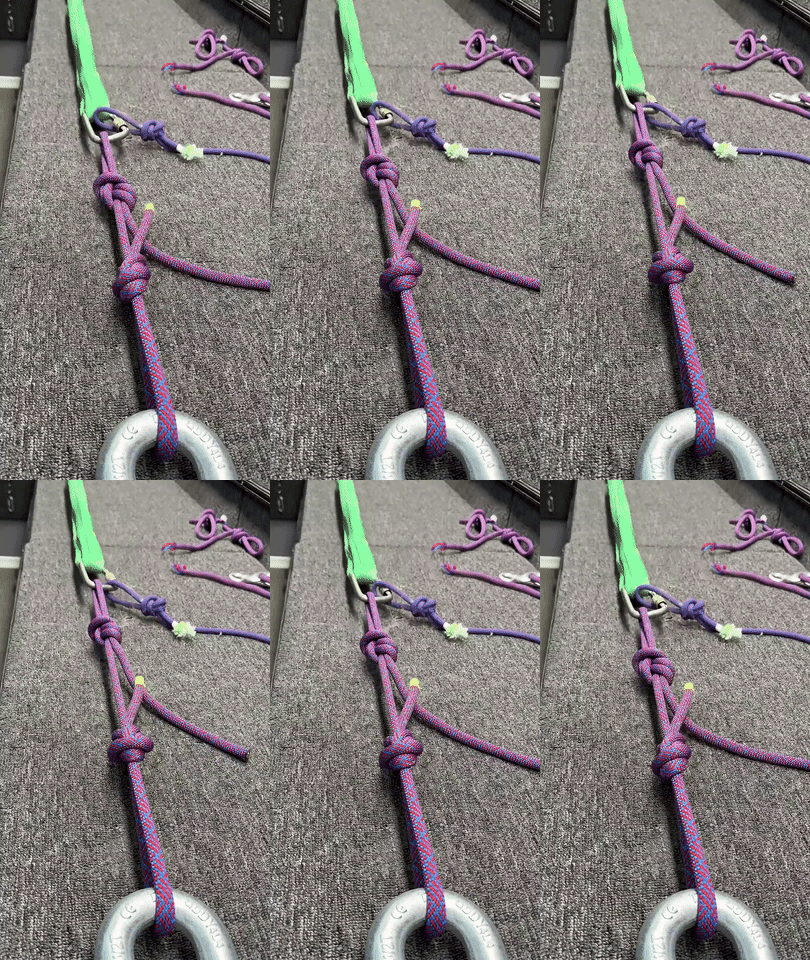
That is, between two ropes of identical diameter and construction subjected to the same load, the one made from the material with the higher Young’s modulus will elongate less.
Climbing rope elongation under load.

Not only the tightening of knots, but also the low Young’s modulus of the material causes nylon ropes to elongate significantly under load.

Source: youtube.com/@HowNOT2

• Specific Modulus
The specific elastic modulus is the ratio of a material’s elastic (Young’s) modulus to its density — or, in the case of textile materials, to its linear density (specific tensile modulus). It is typically expressed in N/tex or gf/den.

This parameter reflects the extent of elastic deformation of textile fibers relative to their mass.

The higher the specific elastic modulus of a material, the less a rope will stretch at the same mass.

In other words, of two ropes with identical construction subjected to the same load, the one that stretches less and is lighter will be made from the material with the higher specific elastic modulus.
Relationship between specific strength (tenacity) and specific elastic modulus for various materials.
Source: «Handbook of Properties of Textile and Technical Fibres», Second Edition by A.R. Bunsell, 2018.

Elongation

In the context of textile materials elongation refers to the degree to which fibers or yarns stretch under load, as well as their ability to absorb energy.

Ropes made from materials with high elongation can stretch further and absorb more energy under dynamic loads, whereas ropes with low elongation maintain their shape better and respond more sharply to applied forces.

Elongation can be absolute or relative. Absolute elongation measures the change in length in physical units (millimeters, centimeters, meters, etc.), while relative elongation expresses the extent of stretch relative to the material’s original length as a percentage (%).

The degree of elongation in textile materials depends on:
  • The structure of the polymer fiber and its inherent properties, in particular the relationship between tensile strength, elastic modulus, and ductility*;
  • The magnitude of the load and the rate at which it is applied;
  • Environmental conditions such as humidity, temperature, and so on.

*Ductility refers to a material’s ability to undergo significant plastic (i.e., permanent) deformation before breaking.
Relationship between specific strength (tenacity) and relative elongation for fibers made from various materials.
Source: «Handbook of Properties of Textile and Technical Fibres», Second Edition by A.R. Bunsell, 2018.
A special case of elongation, often used to compare textile materials, is elongation at break
Elongation at Break
Elongation at break reflects the relative elongation of a textile material at the moment its breaking load is reached. In simple terms, it indicates how much a fiber, yarn, or rope can stretch before failure.

Materials with higher elongation at break absorb energy more effectively, thereby reducing sudden impacts and lowering the risk of rope failure during dynamic loading.

Elongation at break of various fibers used in rope manufacturing
For a detailed analysis and comparison of the elasticity and strength of various textile materials, deformation diagrams are used. These graphs represent the relationship between stress (or load) and deformation (elongation or compression) of a material.
An example of a deformation diagram for textile fibers.
The point labeled “yield point” marks the tensile stress at which the material begins to undergo plastic (irreversible) deformation.
Source: «Handbook of Properties of Textile and Technical Fibres», Second Edition by A.R. Bunsell, 2018.

It is important to note that a high elastic modulus combined with low elongation at break is not always the goal or an indicator of quality for materials used in rope manufacturing. In rock climbing, mountaineering, slacklining, and rope jumping, elastic ropes and webbings are often preferred because their ability to stretch allows them to effectively absorb the energy of dynamic impacts and sudden loads. This is why nylon, one of the most elastic rope materials, remains widely used in these disciplines.
Elongation depends not only on the properties of the material itself but also on rope construction. For example, a 3-strand twisted rope will stretch more than a 12-strand braided rope made from the same material. Between two twisted ropes, the one with a higher number of twists per unit length will exhibit greater elongation. In essence, the better the fibers, yarns, and strands within a rope are aligned with the applied load (that is, the less they are twisted), the lower the rope’s “structural” elongation.
Nylon’s elasticity and the design of dynamic ropes allow climbers’ falls to be arrested smoothly
Thanks to nylon’s elasticity and the design of dynamic climbing ropes, such falls can be safely arrested without compromising the rope’s integrity or the climber’s safety.
Source: youtube.com/HardIsEasy

International Standards Used to Evaluate the Strength, Elastic Modulus, and Elongation of Textile Fibers and Yarns

Standards of the International Organization for Standardization:
  • ISO 5079 «Textile fibres — Determination of breaking force and elongation at break of individual fibres».
  • ISO 2062 «Textiles — Yarns from packages — Determination of single-end breaking force and elongation at break using constant rate of extension (CRE) tester».

Standards of the American Society for Testing and Materials:
  • ASTM D3822 «​​Standard Test Method for Tensile Properties of Single Textile Fibers».
  • ASTM D2256 «Standard Test Method for Tensile Properties of Yarns by the Single-Strand Method».
  • ASTM D7269 «Standard Test Methods for Tensile Testing of Aramid Yarns».
  • ASTM D3217 «​​Standard Test Methods for Breaking Tenacity of Manufactured Textile Fibers in Loop or Knot Configurations».
  • ASTM C1557 «​​Standard Test Method for Tensile Strength and Young’s Modulus of Fibers».

European standards:
  • EN 13895 «Textiles — Monofilaments — Determination of tensile properties».
  • EN 14621 «Textiles — Multifilament yarns — Methods of test for textured or non-textured filament yarns».
  • EN 13003 «Para-aramid fibre filament yarns».
  • EN 12562 «Para-aramid multifilament yarns — Test methods».

Creep

Creep is the slow, irreversible elongation of a textile material under a constant load, even when the load remains within the elastic limit*.

In the worst cases, this process can result in complete “creep failure” of the rope.
*The elastic limit is the maximum stress a material can withstand while still fully returning to its original shape once the load is removed. Exceeding this stress causes irreversible (plastic) deformations in the material.
Creep occurs as a result of the gradual rearrangement of molecular chains and intermolecular bonds under a sustained load. The rate of this process depends on the material’s properties, the magnitude and duration of the load, and the temperature.

High creep resistance is critical in slacklining, marine rigging, mooring systems for floating oil platforms, wind turbines, and other applications where ropes and webbings need to maintain their length under prolonged static loads, sometimes lasting decades.

A large-diameter polyester rope used in deep-water mooring systems.
Source: maritimedevelopments.com
Creep is described by a creep curve, which shows the deformation of a material over time under a constant load and temperature. It is typically divided into three stages:

  • Stage I – Primary creep: initially high but rapidly decreasing deformation rate.
  • Stage II – Secondary creep: the longest stage with a roughly constant deformation rate.
  • Stage III – Tertiary creep: accelerated deformation rate leading to material failure.

Creep curve of Kevlar® 29 fiber.
Creep curve of Kevlar® 29 para-aramid fiber.
The test was performed under a tensile stress of 2.1 GPa, equal to 85% of the fiber’s ultimate tensile strength (2.48 GPa).
Source: «Fatigue and creep of high-performance fibers – Deformation mechanics and failure criteria», 2008.
In practice, creep affects most ropes only after years of continuous use. For instance, a Dyneema® SK78 rope used for mooring a mobile drilling rig for five years at 20% of its MBL and 16 °C stretched by 1.7% due to creep. Its projected service life under these conditions is 17 years.

This example shows that real-world creep testing, even for a small set of materials, would demand immense time and financial resources due to the many influencing factors. As a result, creep tests are typically performed in accelerated conditions with higher loads and temperatures, and the results are then extrapolated to normal operating conditions using specialized mathematical models.

Comparison of creep behavior of different HMPE fiber grades from the Spectra® and Dyneema® brands.
Source: «Handbook of Properties of Textile and Technical Fibres», Second Edition by A.R. Bunsell, 2018.

Deformation Properties of Polymer Fibers Used in Synthetic Ropes
  • 1 GPa = 1000 MPa = 1000 N/mm² = 100 daN/mm²
  • 1 N/tex ≡ 1 GPa ÷ material density (g/cm³)
  • 1 N/tex = 100 cN/tex = 10 cN/dtex ≈ 11.33 gf/den

* Elongation of some materials can increase when exposed to moisture. This is especially true for nylon, which can stretch up to twice as much when wet. The reasons for this phenomenon are discussed in detail in Part III of this series, as well as in the article The Effect of Water on the Properties of Dynamic Ropes.”

In addition, the elongation of all materials considered here depends on temperature (to varying degrees) and increases as temperature rises.

This concludes Part I of our longread on the properties and characteristics of synthetic materials used in the production of modern fiber ropes. In the next part, we will focus on other important parameters, such as abrasion resistance, cut resistance, and the coefficient of friction.

Did you find an inaccuracy?

Would like to commend, criticize or hire?

Contact me on bikulov.r.a@gmail.com or telegram

For more articles please visit the knowledge section

You can also financially support the author's work here


Renat Bikulov

Author

Did you find an inaccuracy?
Would like to commend, criticize or hire?
Contact me on bikulov.r.a@gmail.com or telegram
For more articles please visit the knowledge section
You can also financially support the author's work here
Renat Bikulov
Author
Share:
Subscribe:
Made on
Tilda