


The Effects of Water on the Performance of Dynamic Climbing Ropes

Keep in mind that the relevance of information might change over time.
- Introduction: How Often Does Your Climbing Rope Get Wet?
- Studies on the Effects of Water on Dynamic Ropes and Polyamide
- The Effect of Water on the Weight, Dimensions, Static Strength, and Handling of Dynamic Ropes
- The Effect of Water on the Dynamic Performance of Climbing Ropes
- The Effect of Repeated Contact with Water on Dynamic Ropes
- The Effect of Repeated Contact with Salt Water on Dynamic Ropes
- The Effect of Icing on the Properties of Dynamic Ropes
- How Water Reduces the Strength of Dynamic Ropes
- Dry Treatment as a Way to Reduce the Negative Effects of Water on Dynamic Ropes
- Should a Climber Be Afraid of Water?
- Practical Takeaways for Wet Dynamic Ropes
- What We Still Don’t Know About Wet Dynamic Ropes
How Often Does Your Climbing Rope Get Wet?
Does the rope merely get heavier and dirtier, or is the problem more serious than that? Will it lose some of its dynamic performance and tensile strength, become stiffer, shorter, and start slipping through belay devices?
The internet is full of myths on this subject. Some people argue that wet ropes should not be trusted at all. Others insist that they have taken countless falls on old ropes soaked to the core — and nothing (bad) happened.
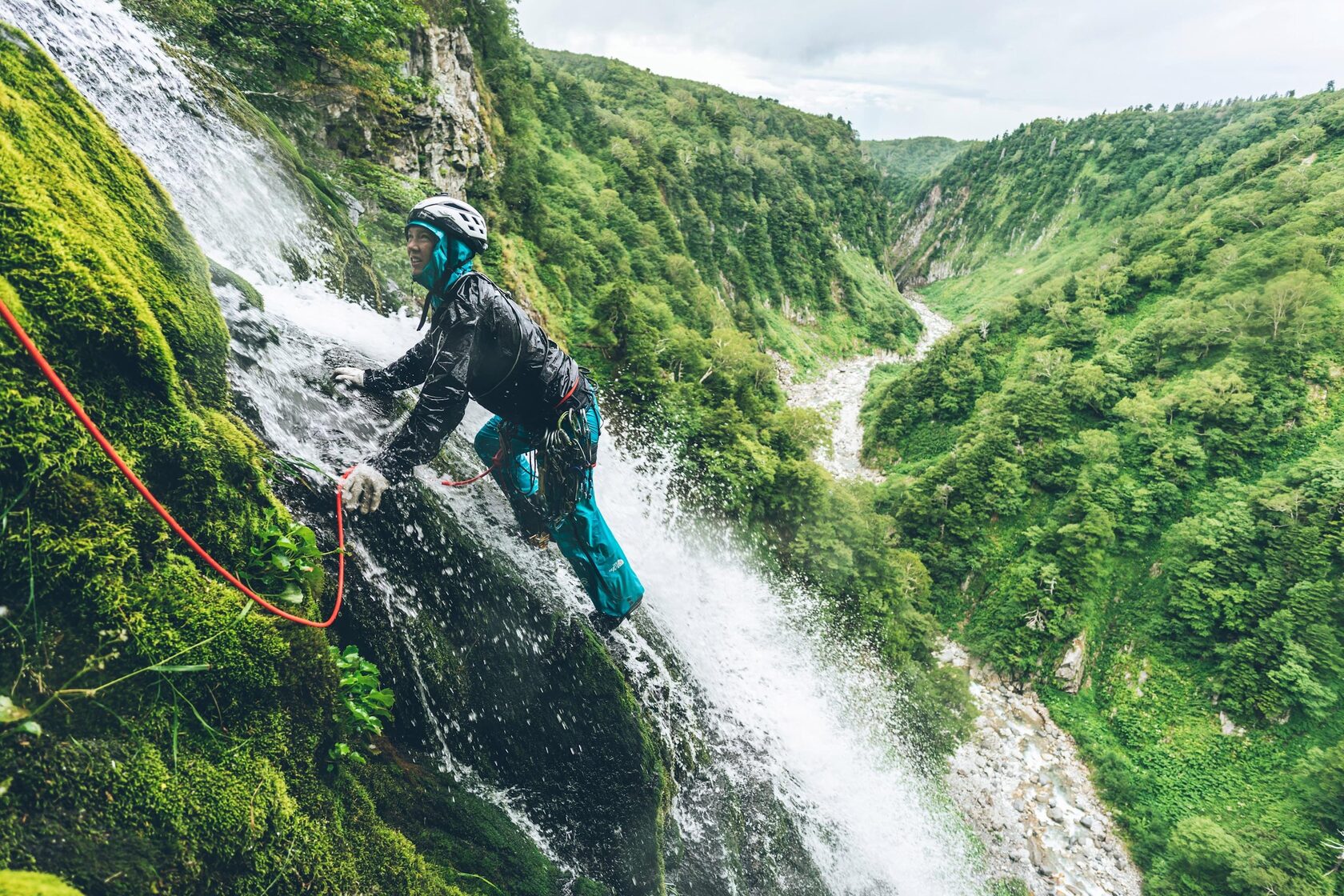
Source: thenorthface.co.uk
Every major claim you’ll find here is supported by links to relevant studies or data from manufacturers’ websites. In addition to listing the many negative effects water can have on a dynamic rope, the article also explains the causes of some of these phenomena and offers recommendations on how to avoid or reduce them. It concludes with my own attempt to translate this scientific knowledge into real climbing and mountaineering practice.
But before we begin, given the scope of the topic and the ambiguity of some of the conclusions, I need to make a few important caveats:
- The points made in this article apply exclusively to dynamic ropes made of polyamide and built with a kernmantle construction. Although many of the conclusions drawn for dynamic ropes may also be relevant to static ropes made from the same material, I have chosen not to make that comparison here, so as not to complicate an already difficult subject.
- Most of the conclusions in this article are not universal. The reason is simple: the available research is limited. Each study relies on a small number of samples from specific rope models, tested under specific conditions and often by very different methods. In one case, wet rope samples were tested dynamically with a 44 kg mass and a fall factor of 1 [5]; in another, the authors followed EN 892 and dropped an 80 kg mass at FF 1.7 [10]. Some studies broke wet ropes on a tensile-testing machine [2]; others statically loaded ropes that had already dried but had gone through repeated wetting beforehand [7, 8]. The soaking procedures also vary widely, both in method and in duration — from a couple of hours to several days. On top of that, the sample size varies greatly, and in some cases it is simply too small, with too much scatter in the results, to support statistically strong conclusions. Differences in rope design and manufacturing technology complicate matters further, especially since those technologies keep changing and manufacturers usually do not disclose the details. That means that the characteristics of ropes may already have shifted since the oldest studies cited here, especially those published between 2001 and 2011. Water-repellent treatments are an obvious example: both their chemistry and the quality of their application have clearly changed under the influence of the 2014 UIAA standard and broader environmental pressures. Could that have affected the results of newer studies and made some older conclusions obsolete? Certainly. The point is not to dismiss the research, but to remember that there is no single definitive study here, and no perfectly final answer either. What matters most is not the exact figures quoted in this article, but the broader patterns they reveal — and your ability to apply those patterns to your own situation.
To make the terminology easier to follow and help the reader get into the subject more quickly, I recommend first reading about rope construction, manufacturing, and testing. My articles How Dynamic Ropes Are Tested under the EN 892 Standard and How Climbing Ropes are Made are good places to start.


Studies on the Effects of Water on the Properties of Dynamic Ropes and Polyamide
- Are Wet Ropes Dangerous for Climbers? Textile Science Explained, 2023
- Do wet climbing ropes break weaker? / Do wet climbing ropes break weaker?, 2022
- Frozen ropes tested – Are they weaker? / Are Frozen Climbing Ropes Weaker?, 2022
- Ageing of climbing ropes with and without hydrophobic coating, 2021.
- Influence of moisture on functional properties of climbing ropes, 2011.
- Investigation of the water repellence of different experimental and commercial coatings for synthetic mountaineering ropes, 2008
- Investigation into the effectiveness and durability of waterproof coatings and heat treatments of dynamic climbing ropes, 2007.
- An assessment of the effect of water absorption on the mechanical properties of dynamic climbing ropes 2006.
- Water absorption and the effects of moisture on the dynamic properties of synthetic mountaineering ropes, 2005.
- An assessment of the effects of environmental conditions on the performance of dynamic climbing ropes, 2005
- The influence of water, ice and sunlight on the dynamic performance of mountaineering ropes, 2002 / Wet and icy ropes may be dangerous, 2001.
12. Understanding the effect of water in polyamides: a review, 2020
13. Influence of water on the short and long term mechanical behaviour of polyamide 6 (nylon) fibres and yarns, 2018
14. Water sorption and transport in polymers, 2002.
15. The influence of water absorption on the properties of polyamide, 1990.

The Effect of Water on the Weight, Dimensions, Static Strength, and Handling of Dynamic Ropes in Belay and Rappel Devices
- Gain weight: on average up to 40% [1, 6, 7, 9, 11], and in some cases up to 60% [2, 11].
- Increase in diameter: by as much as 1 mm [1, 2, 15].
- Increase in length: by up to 5% [2, 11, 15].
- Become less predictable when used with belay and rappel devices: some ropes begin to bind or feed poorly, while others, conversely, slip more readily [1].
- Lose static strength: by up to 15% [2]. Interestingly, contact with fresh water weakens the rope more than contact with salt water [10].
- Show a significant increase in static elongation: depending on the load level, the presence of knots, and the characteristics of the rope itself, wet samples may stretch 30% or more than dry samples of the same model [2].

Compared with a dry sample of the same model, this rope broke at a lower load while showing significantly greater elongation.
Source: youtube.com/HowNOT2
At the same time, tests [1, 2] show that soaking an untreated rope in a bucket of water for five minutes is enough for it to absorb almost its maximum amount of water. Even if you continue submerging the rope for several more hours, or even days, the additional water uptake will be relatively small.
Curiously, dry-treated ropes can still absorb only slightly less water — gaining about 30% in mass — than untreated ropes, which gain about 40% [1, 2, 7]. However, reaching that level of absorption takes noticeably longer. This is because, as long as the water-repellent coating remains intact — not washed out or worn away by friction [6, 7] — it resists water absorption into the rope material and slows water penetration through the sheath or poorly sealed ends into the core. But once water does get inside, it begins, slowly but steadily, to accumulate between the rope fibers and spread along the rope by capillary action [6].

It takes only five minutes for this model to absorb almost its maximum amount of water and become roughly 40% heavier. If this rope had been dry-treated — with both the sheath and core given a water-repellent treatment — there would be fewer bubbles, it would absorb less water, and the process would take significantly longer.
Source: youtube.com/HardIsEasy
The Effect of Water on the Dynamic Performance of Climbing Ropes
- Show greater elongation. The difference compared with dry ropes can reach 20%, while maximum elongation can reach up to 50% of the rope’s original length [5, 6]. Moreover, if several consecutive falls occur, the maximum elongation is reached during the very first fall.
- Produce a harsher catch. The rate of change of acceleration — in other words, the jolt — reached on the second consecutive fall on a wet rope is equivalent to the level reached only on the tenth fall on a dry rope [5].
- Generate higher impact forces [1, 5, 6, 8, 11]. During the first fall on a wet rope, the force on the falling climber is 5–13% higher than on a dry rope under the same conditions. With subsequent falls, repeated at five-minute intervals, both the force and the gap between wet and dry ropes continue to increase [5]. However, the increase in force with each subsequent fall also applies to dry ropes, as discussed in the QC Lab article Do Ropes Need To Rest Between Falls?
- Lose more of their ability to dissipate energy with each subsequent fall when falls are repeated at five-minute intervals [5], while at the same time generating more retrieved energy [1, 5]. To visualize the latter effect, imagine a heavily stretched spring trying to return to its original state. A wet rope behaves in a similar way: after stretching under a severe fall, it contracts again, throwing the climber upward or, worse, forcefully launching them back toward the wall.
When several falls occur with minimal intervals between them, the main changes happen during the first three or four falls. After that, elongation stabilizes at roughly the same level, while maximum impact force and retrieved energy continue to increase only slightly [5].
Sources: youtube.com/HardIsEasy
- Sustain fewer UIAA falls. When wet, the number of standard UIAA falls a rope can hold may decrease by 35–70% [6, 9, 11] compared with the number stated by the manufacturer. This reduction is observed in both new and used ropes, including ropes with water-repellent treatment [11]. Depending on the type of treatment, the number of falls sustained may be either lower or higher than for an untreated rope of the same model [6]. What is especially discouraging is that a rope only needs to absorb 6–16% of its own mass in water for the number of falls it can hold before failure to decrease significantly [9]. In real conditions — in rain or wet snow — getting a rope that wet is not difficult.
A curious fact: ropes that are too “dry” are no better than heavily wet ones — both sustain several times fewer UIAA falls [9]. The reason is that when moisture content drops below a certain threshold, the rope noticeably loses flexibility and resistance to internal wear. Under insufficient moisture conditions, polyamide fibers become stiffer, friction between them increases, and so does the mechanical loss factor. During a fall, this causes a sharp rise in core temperature, additional internal damage, and, as a result, a reduction in the number of falls the rope can sustain. This is why ropes should not be stored in excessively dry and warm places. After being moved back into normal air humidity conditions — around 40–60% — a rope usually needs several hours to recover its nominal properties. And some climbers get to the crag or gym much faster than that…
The Effect of Repeated Contact with Water on Dynamic Climbing Ropes
- Shrink, meaning they become irreversibly shorter. Although I have not found any detailed studies on this particular issue, many well-known manufacturers — including Petzl, Sterling, Cordas, and Mammut (here and there) — state that dynamic ropes can shrink by up to 10% over their service life. The initial shrinkage of a few percent may occur after the very first soaking-and-drying cycle, which is why some recommend doing this immediately after buying a rope. Further shortening depends on many factors and is therefore difficult to predict. It is worth noting, however, that greater shrinkage is usually more typical of entry-level ropes, since simpler technologies are used in their production.
- Lose mass. In studies [7, 8], non-dry-treated ropes lost 3–4% of their original mass after eight soaking-and-drying cycles. The authors explained this by the leaching of some substance from the core, presumably Teflon, which Mammut used to reduce friction between the tested rope strands. Interestingly, no mass loss was observed in dry-treated samples.
- Absorb more water. After seven soaking cycles, the water absorption of untreated samples increased from 43% to 53% of the dry rope mass [7]. At the same time, the water absorption of samples from the same model but with water-repellent treatment remained almost unchanged. This led the authors of the study to conclude that regular wetting does not seriously damage the rope’s water-repellent treatment. A later study [6], however, clarified that some treatments can still be washed out — more precisely, those that do not form covalent bonds with polyamide. What the water-repellent treatment definitely does suffer from is external and internal abrasive wear [6, 7]: friction between the rope and various surfaces, as well as friction between the rope strands themselves. As the effectiveness of the treatment decreases, the rope begins to absorb more water; and as it absorbs more water, it stretches more under load [8] and progressively loses strength [7] due to plasticization, which will be discussed later.
- Suffer a permanent reduction in static [8] and dynamic [1, 11] strength. In one study, after 16 water cycles — each consisting of 8 hours of soaking and 40 hours of drying at room temperature — a dry, untreated rope broke on a tensile-testing machine at a load 32% lower than when it was new [7]. Interestingly, the same rope model with water-repellent treatment had a lower initial strength, but showed no strength loss after eight water cycles. Unfortunately, that rope was not tested after 16 cycles.
After four soaking cycles of 48 hours each, the first-fall impact force on the dried rope decreased by 7% [10]. The author of the study explains this by the 4% shrinkage of the tested sample, although the exact connection between these two phenomena is not specified. I would venture to suggest that shrinkage may have reduced internal tension in the rope fibers, which ultimately led to a lower impact force during the fall. However, since this test was carried out on only one rope model, with just three samples, and dates back to the relatively distant year of 2002 — and since the phenomenon of decreasing dynamic force over repeated soaking-and-drying cycles has not, as far as I could find, been confirmed by any later studies — I will leave it aside for now as merely an interesting observation.

Studies suggest that nylon ropes should not be exposed to water unnecessarily. So instead of washing your rope after every minor contamination, it is better to handle it more carefully and avoid getting it dirty in the first place.
Source: sport-marafon.ru
The Effects of Repeated Contact with Salt Water on Dynamic Ropes
- Lose slightly less mass — about 1.5% — than ropes subjected to the same treatment in fresh water, which lost about 3%. According to the authors of the study [8], soaking an untreated rope in salt water washes various factory-applied coatings or finishes out of the core in much the same way as soaking it in fresh water. In the case of salt water, however, this process is partly offset by the deposition of some of the salts and minerals inside the rope. It is also possible that samples exposed to salt water do not dry completely in the core because of the hygroscopic properties of the salt itself.
- Begin to absorb less water. After six salt-water cycles, the wet mass of untreated rope samples began to decrease, while similar samples exposed to fresh water continued to absorb more water with each subsequent cycle [8].
- May accumulate crystallized salt, which, according to the manufacturer Kordas, can damage rope fibers by acting as an abrasive.
- Show a greater reduction in static strength — by 0.34 kN on average — than untreated ropes subjected to the same preconditioning procedure of eight cycles, but in fresh water [8].
Otherwise, the same conclusions apply to ropes that have seen a lot of salt water as to ropes that have repeatedly been exposed to fresh water. This means that climbing at seaside crags poses only slightly more risk to a dynamic rope than any other type of climbing.

Source: trekandmountain.com
The Effect of Icing on the Properties of Dynamic Climbing Ropes
- Withstand roughly the same static loads as dry ropes. In some tests, the strength of unknotted icy samples — soaked for 24 hours in fresh water and then frozen for 8 days at -25°C — decreased by 5% [10]. In other tests, the strength of samples with figure-eight knots that had been soaked and then left overnight in a freezer, on the contrary, increased by 7% [3].
- Stretch more than dry ropes, but less than wet ropes. At least this was the case under a static load equivalent to 450 kg [10]. By the way, an icy rope should not be confused with a frozen rope. An icy rope is one that first got wet and then became covered with ice. A frozen rope, by contrast, is a rope that was dry to begin with and was then exposed to sub-zero temperatures. A frozen rope stretches less than both an icy rope and a dry rope [10].
- Sustain significantly fewer UIAA falls than dry ropes, but more than wet ropes [11]. While wet ropes sustained only 30% of the number of standard falls stated by the manufacturer, icy ropes — soaked and then kept at -30°C for 48 hours — sustained 50% of the nominal value for dry ropes.
- Show a decrease in first-fall impact force compared with a dry rope, by 10% on average [11].
The last two findings, in particular, do not fit well with the common belief that falling on an icy dynamic rope is only slightly different in harshness from falling on a steel chain. Still, I do not think a single study is enough to tell climbers to forget all fear of such entertainment. The author himself notes that simply fixing the rope in the test apparatus — already at +20°C — took about five minutes. That does not even include the time needed to prepare for the next drop, or the heating of the rope that occurs during each subsequent fall. In other words, during the study [11], the rope remained truly frozen only at the initial stage of the test.
Interestingly, the author then suggests that if conditions had been created to keep the rope frozen throughout the entire test, the results might have been even better — that is, closer to those of a dry rope. After all, “at low temperatures the crystalline structure of a wet/frozen rope, especially the mobility of its amorphous part” — more on this below — “would be the same as that of a dry rope at normal temperature” [11].

The rope broke at the knot, showing slightly higher strength than a dry sample of the same model.
Source: youtube.com/HowNOT2
How Water Reduces the Strength of Nylon Ropes
The reason is as follows:
- At the molecular level, water acts as a plasticizer for polyamide, weakening the hydrogen bonds in its amorphous regions [1, 12, 15]. This process lowers the glass transition temperature of polyamide, making the material softer and more flexible while also reducing its mechanical properties, especially its yield strength. As a result, the rope stretches more under load, while its ability to absorb the energy of a fall and resist breaking decreases.
Polyamide plasticization is reversible, but only partially. This can be seen in the fact that after a rope is dried, its strength recovers to values close to, but not equal to, the original ones [10]. As the number of wetting events increases, the negative effect accumulates, gradually and permanently reducing the rope’s breaking strength [8].

Water molecules penetrate the amorphous regions of the polymer structure and weaken intermolecular hydrogen bonds by forming hydrogen bonds with amide groups. As a result, the rope stretches more under load. Once the water evaporates, however, polyamide recovers its mechanical properties almost to their original state.
Source: youtube.com/HardIsEasy
- During a fall, the surface temperature of the rope at the bend point can exceed 70°C [9]. It is therefore assumed that the temperature inside the core at that same moment may exceed 100°C. Such high temperatures cause moisture inside the rope to evaporate and turn into steam. High temperature and steam pressure, in turn, accelerate the hydrolysis of polyamide. As a result, Young’s modulus and yield strength decrease [14], while the glass transition temperature of polyamide drops to room temperature or even lower [15]. As in the previous case, this reduces the ability of the rope fibers to dissipate fall energy through deformation. This leads to fiber damage and, consequently, to a lower number of falls the rope can sustain.
Scientists note that the effect of water on nylon is comparable to a substantial increase in its temperature. In other words, testing a wet rope at room temperature is not much different from testing a dry rope at 70–80°C [11]. No wonder the rope loses some of its dynamic properties in the process.

Source: theuiaa.org
- Water acts as a lubricant in the rope, reducing the coefficient of friction between its fibers [1, 6, 15]. As friction decreases, the rope stretches more under load, while the amount of energy it can dissipate at that moment decreases. As a result, the additional elongation does not help absorb the fall. On the contrary, it works against the climber by increasing both the fall distance and the loads generated during the fall [9].
The elongation of dynamic ropes and their ability to absorb energy may also be affected by the fact that ropes increase in length as they absorb water — by as much as 5% in some tests [2, 11, 15]. Thus, when the rope is loaded, part of its potential to stretch and absorb the fall has already been used up [11].

Source: youtube.com/HardIsEasy
- Although absorbed water may slightly reduce friction between polyamide fibers, it can substantially increase their wear rate [14]. As a result, wet fibers may accumulate damage faster under rubbing, which can ultimately reduce the strength of the entire rope.
Dry Treatment as a Way to Reduce the Negative Effects of Water on Dynamic Ropes
In practice, however, avoiding water altogether is not realistic. Morning dew may settle on a rope left under a tarp; rain or wet slushy snow may soak it halfway up a route; or the rope itself may become so covered in dirt that washing it is no longer avoidable.
If you regularly deal with situations like these, you should definitely consider ropes with a full water-repellent treatment — commonly marketed as dry-treated ropes, or simply “dry ropes.” In such models, both the core and the sheath are treated with a special compound that helps prevent water from penetrating into the rope and being absorbed by the material.
Sources: youtube.com/WeighMyRack

Source: youtube.com/HardIsEasy
That said, the studies in question were carried out before the introduction, in 2014, of the newer and stricter UIAA Water Repellent standard, which includes, among other things, simulated rope wear — and therefore wear of the dry treatment itself — before testing. Whether this has significantly improved the quality of water-repellent treatments remains an open question. But those who believe it has should remember that UIAA certification for dynamic ropes is entirely voluntary. This means that not every rope marketed as "dry" will necessarily meet the standard’s requirements. So when buying a rope, check for the appropriate marking.
Should a Climber Be Afraid of Water?
When you first look at the research results, the scariest part is how much water can affect the number of falls a dynamic rope can hold before failure. In some cases, the number of standard falls may drop to one-third of the value stated by the manufacturer. And that is for a brand-new rope! Remember that under the European standard EN 892 and the UIAA-101 standard, a new certified dry single rope must hold at least five such falls. But what kind of falls are we talking about? An 80 kg steel mass, which has nothing in common with the dynamics of a human body, is dropped with a fall factor of 1.7 and arrested by a fixed clamp that, unlike a living belayer, neither moves nor lets any rope slip. The interval between falls is only five minutes, and the load is applied to the same section of rope every time — the very section where the rope eventually breaks.
Now ask yourself: how often do you fall a distance 1.7 times greater than the length of rope paid out by the belayer? And how often does that happen several times in a row? And on a wet rope?

Source: youtube.com/HardIsEasy
So even if we assume that falls on a thoroughly wet rope become harsher and the impact force increases by 10–15% — although the latter is not entirely certain [2] — this will most likely be a problem for your comfort rather than your safety.
The point is that a “standard UIAA fall” and a standard climbing fall are very different things. The value of such severe laboratory conditions is not that they accurately imitate reality, but that they give dynamic ropes a substantial safety margin, including in case the rope gets wet. That is the encouraging side of the story.

Source: youtube.com/edelrid
The same applies to falling the full length — or even twice the length — of a personal tether made from a piece of dynamic rope. Such a lanyard may seem short, perhaps only a meter long. But climb above the anchor and slip, and the fall factor will exceed 1, producing very unpleasant loads both on the climber and on the anchor to which the tether is attached. And I will not even get into the loads generated during a fall in which nuts or pitons rip out of the rock...
The point is that all of these are dangerous situations regardless of the rope’s condition. Water can certainly make the consequences worse, but I still find it unlikely that people who are already willing to accept this level of risk will abandon their climbs simply because their rope got wet. As the saying goes: “Just don’t fall.”

Practical Takeaways for Wet Dynamic Ropes
It is simple: after every serious fall, switch rope ends. In other words, untie and tie back into the opposite end of the rope. This way, the next fall is absorbed by a knot that has not yet been tightened under load, and by a section of rope that has not yet lost its dynamic capacity. That should make the next catch softer both for the rope and for you. Just remember that the next fall on a wet rope may produce maximum elongation. This matters if there is a ledge nearby that you really do not want to hit.
I will keep the remaining conclusions and recommendations brief:
- Wet dynamic ropes have a limited effect on the safety of sport climbing. Yes, they become heavier, shrink, absorb abrasive particles together with water, wear faster, feel stiffer to the touch, and produce slightly harsher catches. But they certainly do not just snap.
- In multipitch climbing, ice climbing, and mountaineering, wet dynamic ropes deserve more caution. If there is a chance of a serious high-factor fall, and the rope is soaked through and no longer exactly new, it is better to abandon the climb if possible.
- If you do rope jumping (aka rope swing), where a doubled dynamic rope is subjected to dozens of relatively soft but still real catches in a single day, pay special attention to the increased elongation caused by rain or morning dew. Extra stretch during the first catch — theoretically up to 30% — can add a huge amount to the fall distance when the rope is 20, 50, or 100 meters long. To avoid a harsh catch and preserve the rope’s strength, once the rope gets wet you should also stop doing tandem jumps and other demanding rope-jumping “entertainments.”
- If you use a dynamic rope as a fixed line for ascending or rappelling, remember that when wet it will stretch much more and will also rub and wear more heavily against the rock.
- If you are choosing a rope specifically for wet conditions and serious loads, give preference to thicker models with a higher number of standard falls, and a dry treatment certified to the UIAA Water Repellent standard.
- The dynamic potential of icy ropes remains an open question. But even if we assume that an ice-covered dynamic rope can absorb fall energy effectively, that does not mean you will be able to use it properly. Such ropes become stiff as a rod, do not feed well through belay and rappel devices — except perhaps a figure-eight or a Munter hitch — and ascenders and friction hitches may not hold on them reliably. As for water-repellent treatment, it cannot fully prevent moisture from entering the rope, and it only partially helps against icing.
- You can wash a dynamic rope, but only if done properly — and preferably not too often. For what “properly” means, see the manufacturer’s instructions. As for washing frequency, it is important to understand that water has a cumulative negative effect on the rope and slowly but permanently reduces its strength. So rather than washing your rope too often, it is better to protect it from dirt in the first place — for example, by using rope bags and rope mats. On the other hand, dirt, sand, chalk, and other abrasive particles can damage a rope from the outside and the inside, and much faster than water does. So continuing to use a dirty rope just to avoid getting it wet one more time is definitely not the answer :)
- Dry the rope thoroughly, ideally by hanging it in a cool, well-ventilated room, away from heat sources and UV light. Once dry, a dynamic rope recovers its properties almost to their original values.
- Got your rope wet and started doubting its reliability? Do not take the risk. There are plenty of ropes. There is only one of you.

I am pretty sure the rope did not stay dry.
Credits: Cristian Pondella
What We Still Don’t Know About Wet Ropes
In fact, some answers only raise more questions. For example, I am still curious about the following:
- How much do icy dynamic ropes elongate under static loads and falls in real conditions — at -30°C, not in a laboratory? Can an ice-covered rope really absorb fall energy effectively?
- Why do ropes without water-repellent treatment absorb more moisture with each subsequent wetting cycle?
- What determines how wet dynamic ropes behave in different belay and rappel devices?
- Do dynamic ropes really become stiffer to the touch when wet? And if so, why?
- How long does it take to dry ropes under different conditions?
- How far can the conclusions discussed here be extrapolated to static nylon ropes?
And what questions are you interested in?

- Introduction
- Studies on the Effects of Water on Dynamic Ropes
- The Effect on Weight, Dimensions, Strength, and Handling
- The Effect on Dynamic Performance
- The Effect of Repeated Contact with Water
- The Effect of Repeated Contact with Salt Water
- The Effect of Icing
- How Water Reduces the Strength of Dynamic Ropes
- Dry Treatment
- Should a Climber Be Afraid of Water?
- Practical Takeaways
