PART I: COEFFICIENT OF FRICTION & THERMAL CONDUCTIVITY
In climbing circles, Dyneema is the best-known trade name for high-modulus polyethylene (HMPE). It belonged to DSM until the company was acquired by Avient Corporation in 2022.
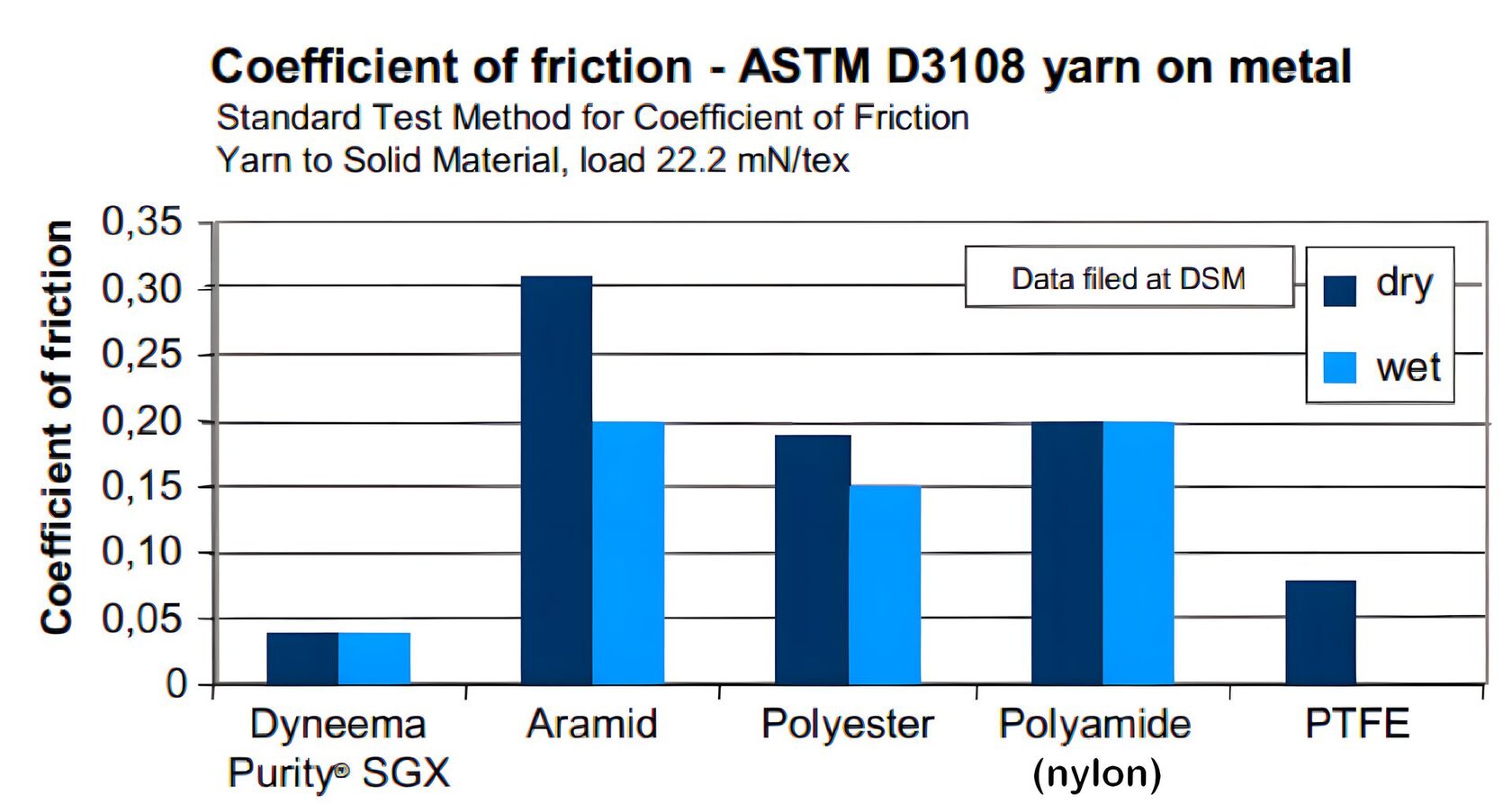
HMPE — also known as UHMWPE — is characterized by extremely high tensile strength, very low elongation, and hydrophobicity, along with a very low coefficient of friction and a low melting point (144–152 °C), especially when compared to more common materials such as Polyamide and Polyester (~250 °C).
HMPE — also known as UHMWPE — is characterized by extremely high tensile strength, very low elongation, and hydrophobicity, along with a very low coefficient of friction and a low melting point (144–152 °C), especially when compared to more common materials such as Polyamide and Polyester (~250 °C).
Because of this last point, ropes made of pure Dyneema are generally considered completely unsuitable for use as rappel lines or friction hitches. However, H. W. Stockman and Walter Siebert — both of whom have rappelled on 3 mm cords dozens of times — take a rather different view. Stockman laid out his arguments in the excellent article “Dyneema and Not Dying,” while Siebert presents his approach on his YouTube channel. Their key arguments — with a few additions of my own — are what we’ll be discussing below.
So, myth No. 1:
A Dyneema rope/cord will inevitably melt during a descent.
This is indeed true if you descend at high speed using standard rappel devices. But if you use specialized “horned” models — or, better yet, a Munter or Double Munter (aka Super Munter) hitch on an H-frame carabiner to provide additional friction and control — the picture changes significantly.
Because Dyneema:
• Has an extremely low coefficient of friction — 3–5 times lower than Polyamide and Polyester. In other words, Dyneema is very slippery, which means it tends to heat up less itself and transfers less heat to the surfaces it contacts.
• Has an extremely low coefficient of friction — 3–5 times lower than Polyamide and Polyester. In other words, Dyneema is very slippery, which means it tends to heat up less itself and transfers less heat to the surfaces it contacts.
• Has only slightly higher radial thermal conductivity (i.e. perpendicular to the rope fibers) than Polyamide and Polyester. As a result, it takes roughly the same — and quite significant — amount of time for heat to penetrate into the rope or to dissipate outward. At the same time, its axial thermal conductivity is more than 15× higher than that of PA and PES. This means that any heat that does manage to enter the Dyneema rope is very quickly distributed and dissipated along its length.
It’s also important to note that rappel speed is not controlled solely by friction between the rope and the descender. A significant part of the braking comes from internal energy losses caused by rope deformation (bending) as it passes through the device or carabiner. The heat generated in this process is minimal, and it is quickly distributed along the Dyneema fibers, without having time to transfer to the contacting device or carabiner to a dangerous degree — precisely because of the thermal properties discussed above.
So which descent method relies least on rope-to-metal friction and most on rope deformation and rope-on-rope friction? The answer is — the Munter hitch.
This is exactly the method used by Mr. Stockman — as well as by the European rescue teams he cites in his article — when descending on Dyneema cords and ropes.
PART II: SK99, BRUMMEL SPLICE, MUNTER HITCH, AND THE RIGHT CARABINER PROFILE
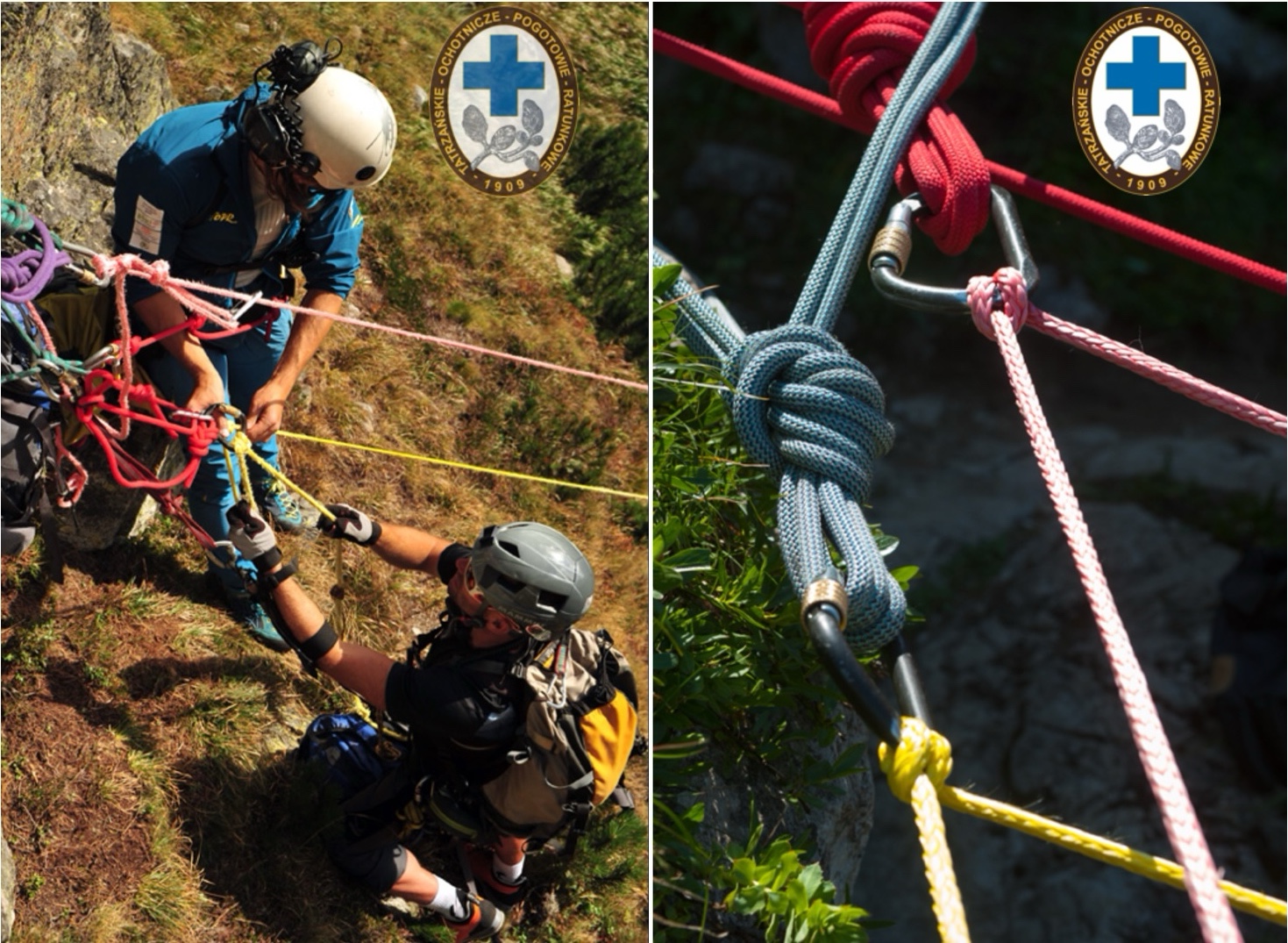
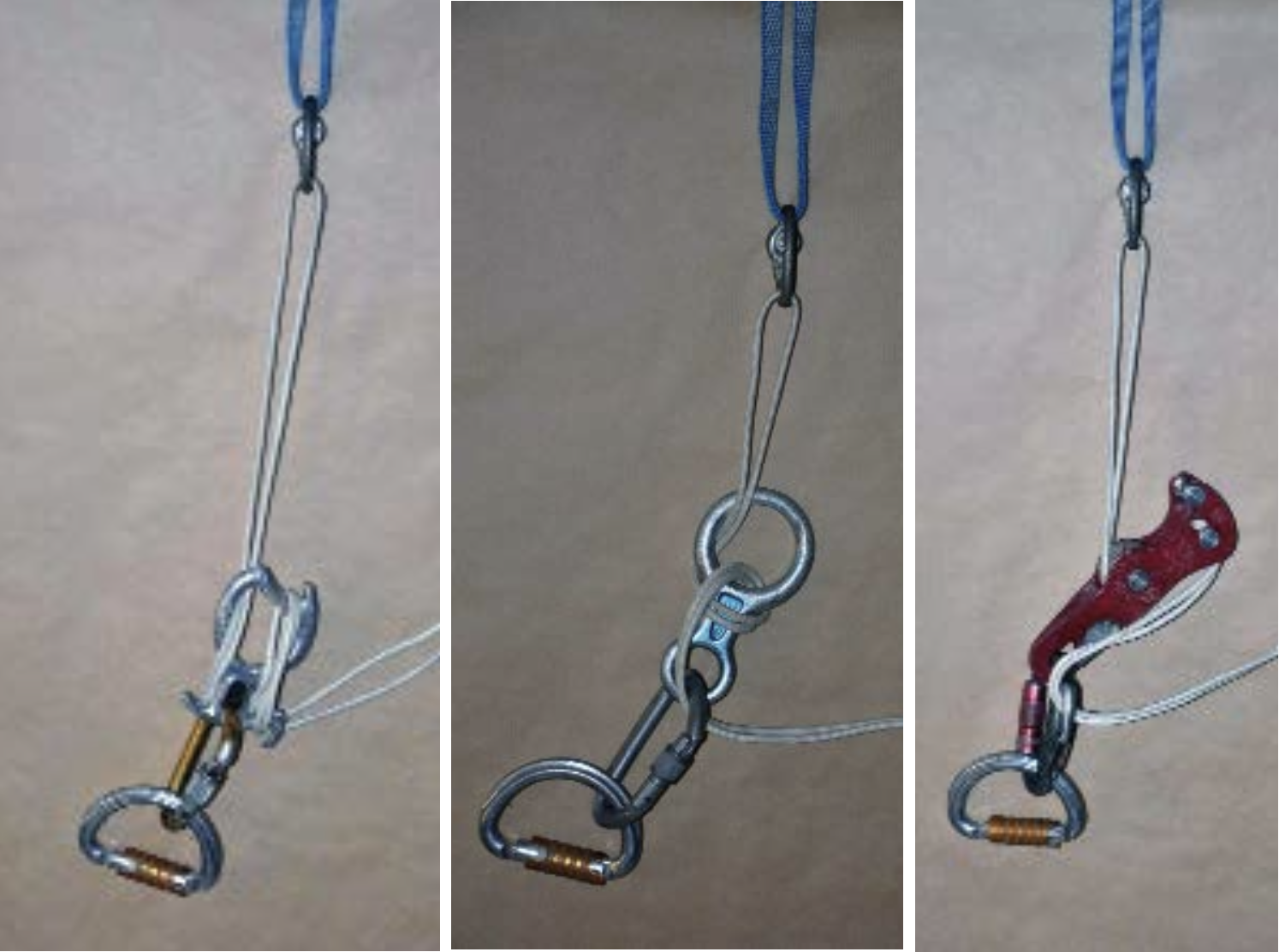
As Mr. H. W. Stockman demonstrates in the video, when using a Double Munter hitch (aka Super Munter), a controlled descent is possible even on Dyneema as thin as 2.8 mm.
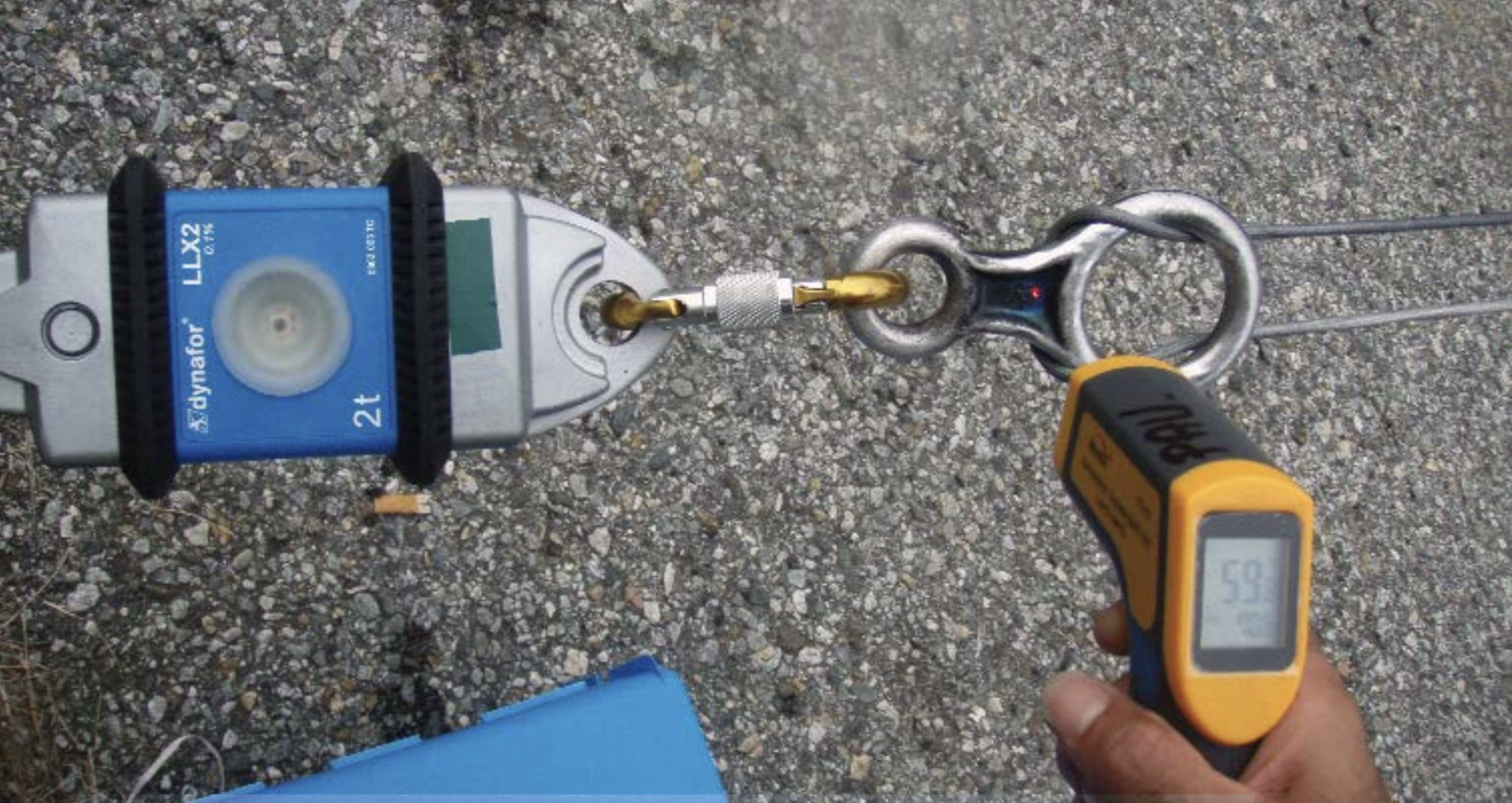
Rappelling this way from 30-meter cliffs, Stockman compared cords made from different materials. He noted that while the descent on 6 mm pure Dyneema was indeed faster, the carabiner heated up by only 11–14 °C more than usual. In contrast, a polyester-sheathed cord of the same diameter managed to heat the carabiner by more than 56 °C, earning Mr. Stockman second-degree burns.
French canyoneers from EFC, descending on 5 mm Beal Dyneema cord (the sheathed version) using horned Piranha-style devices and standard figure-eights (with additional wraps for friction), recorded average device temperatures of around 40 °C, with a maximum of 72 °C reached during a 100-meter rappel. Note that these figures refer to the temperature of the devices themselves, not the Dyneema in contact with them — which was, of course, cooler at the time.
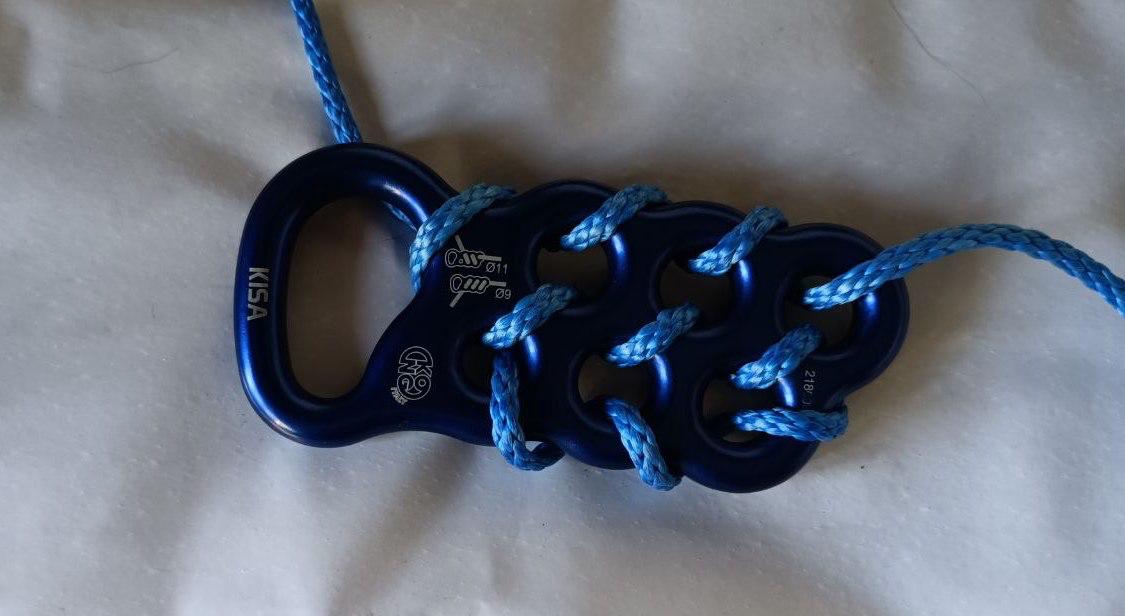
On the Russian paragliding forum, a user who tested unsheathed Dyneema on a DIY-descender based on a KONG “Kisa” energy absorber wrote the following:
During a 25-meter descent on the device in question, even on a thinner cord — 2.5 mm — I found no signs of melting, although the cord became stiffer to the touch. The descender itself heated up noticeably. By feel, the temperature at the hottest spot was somewhere between 50 and 70 °C. The temperature of the cord was significantly lower (just slightly warm). Apparently, the cord itself has too low a thermal conductivity to heat up noticeably while passing through the device. Hanging stationary in one spot for several minutes also did not result in any melting.
At this point, it’s worth noting that the maximum recommended working temperature of Dyneema for prolonged use is 70 °C. At this temperature, it loses roughly 25–30% of its maximum tensile strength. And this brings us neatly to myth No. 2, which goes something like this:
A knotted 3 mm Dyneema cord isn’t strong enough for rappelling — any shock load and it will snap!
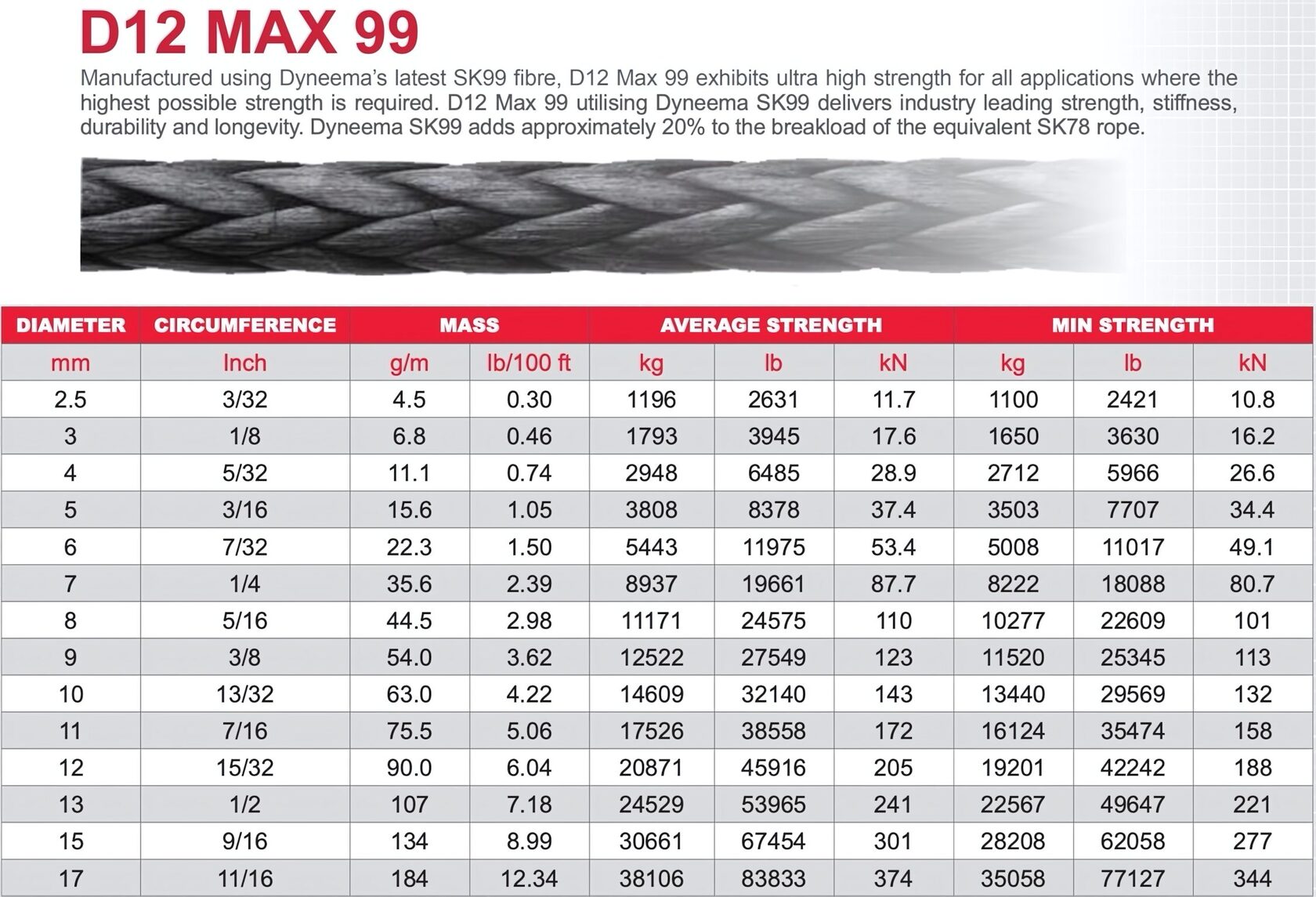
In reality, things are not that dramatic — because not all Dyneema is the same. For example, a 3 mm SK99-type Dyneema cord has a breaking strength of over 15 kN. Even if you tie a knot and lose, say, 60% of that strength, you’re still left with roughly 6 kN. If you then heat the Dyneema to 70 °C (which, as we’ve seen, is not that easy) and subtract another 30%, you still end up with about 4 kN of remaining strength. And that’s on a single strand. If you’re rappelling on a doubled rope (for retrieval afterward), your safety margin is doubled accordingly.
And that’s not all. If you’re working with unsheathed Dyneema, nothing prevents you from using a Brummel splice (see video No. 3) to form an extremely strong eye at the end — one that virtually does not compromise the rope’s strength at all.
The speed of descent on Dyneema is influenced not only by rope diameter, the user’s weight, and knot choice (Munter = less friction, Super Munter = more), but also by the cross-sectional profile of the carabiner.
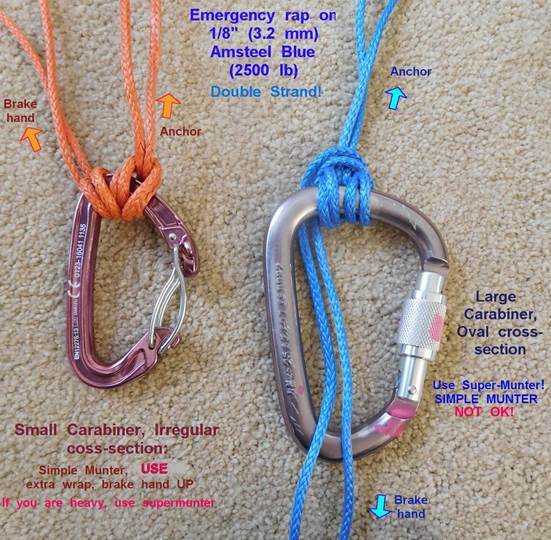
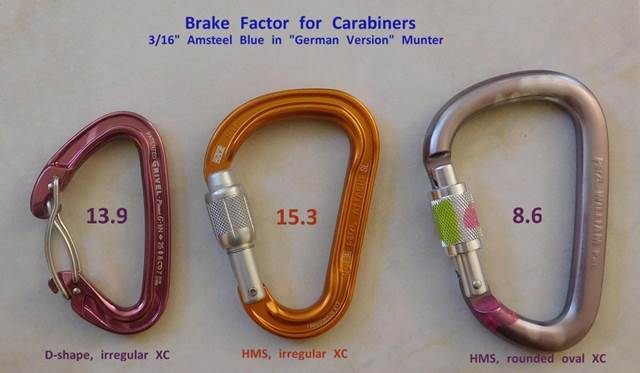
Stockman’s experiments showed that with Dyneema, a large HMS carabiner with a round stock, while dissipating heat better than most other models due to its size, generates too little friction — especially for heavier users — and therefore requires the use of a Double or even Triple Munter. Carabiners with an I-beam (H-profile) cross-section, on the other hand, provide a higher braking factor and allow controlled descents using a standard Munter or a 1.5 Munter (with an additional wrap).
PART III: THE REAL HAZARDS TO WATCH OUT FOR
• Cuts. Despite Dyneema’s low coefficient of friction compared to traditional materials, cutting a cord just a few millimeters in diameter on a sharp edge is not particularly difficult.
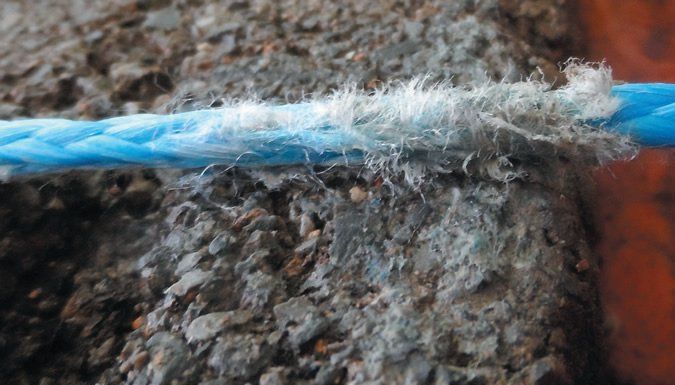
• Abrasion. When not loaded, unsheathed Dyneema has a loose, unstable structure, making it highly susceptible to snagging on the terrain and wearing out quickly.
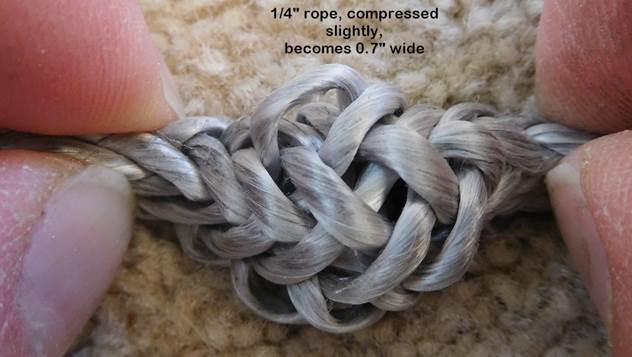
• Severe strength reduction in knots (up to ~60%), and the risk of knots coming undone due to Dyneema’s inherent slickness. When tying knots in Dyneema or other polyethylene cords, cinch them down firmly and leave generous tails.
• Shock Loading. Dyneema is extremely static, so even a minor slip or fall can generate high forces on the user, the anchors, and the rest of the system.
• Fast and prolonged descents (>30 meters) on conventional devices (tubers, belay plates, hornless figure eights) without additional measures to increase friction and slow the descent.
• Using unfamiliar devices, materials, or diameters without prior practice in a controlled and safe environment.
___________________________
*This series is not promoting rappelling on thin ropes. It is genuinely difficult, hazardous, and unquestionably demands experience and preparation. The goal here is simply to share information showing that, in exceptional situations, such descents are possible and — when approached correctly — can be made relatively safe.
