
• 2026 — CME “Deja Vu” caving harness, Russia
Situation: waist double-back buckle failure during an indoor training session.
Outcome: no injuries.
Cause: metal corrosion.
Comment: the harness was regularly used in caves and for gym training; washed, dried, and stored properly; not used on major expeditions; condition appeared normal at first glance; service life — 6 years; user weight ~100 kg.
Situation: waist double-back buckle failure during an indoor training session.
Outcome: no injuries.
Cause: metal corrosion.
Comment: the harness was regularly used in caves and for gym training; washed, dried, and stored properly; not used on major expeditions; condition appeared normal at first glance; service life — 6 years; user weight ~100 kg.

• 2024–2025 — climbing harness waist buckle opening / loosening during highlining, Brazil and France
Situation: two serious highline incidents involving climbing harness waist buckles. In the 2024 Brazil case, a highliner took a leash fall during the Choose Life Festival and the harness reportedly opened completely rather than merely loosening. The user managed to grab the leash, recover, and was then rescued by another participant. In the 2025 France case, during a freestyle highline session in Marseille, a new Petzl Hirundos harness gradually loosened during a leash fall until the waistbelt strap reached the buckle stop.
Outcome: no injuries.
Cause: not confirmed. The likely mechanism is related to the use of climbing harnesses in highline conditions: repeated dynamic loading, unusual body positions, inverted falls, changing load angles, movement of the leash and tie-in knot near the buckle, and cyclic shaking or unloading/reloading of the waistbelt. These conditions differ significantly from the loads for which climbing harnesses are normally designed, tested, and certified.
Comment: complete opening of a waist buckle appears to be rare, but partial loosening of climbing harnesses during highline sessions is widely reported. After the 2025 France incident, the user received many comments from other highliners describing similar loosening problems, not only with Petzl harnesses and not only with one specific buckle design. Manufacturers tend not to treat this as a product failure, since climbing harnesses are generally not approved for slackline or highline use and are therefore being used outside the manual.
Until certified highline-specific harnesses become widely available, a practical interim measure is to tie a stopper knot on the waistbelt webbing behind the buckle after final adjustment. This should not replace proper harness selection, inspection, adjustment, and buddy checks, but it can reduce the chance of progressive loosening or accidental buckle opening during a session.
Source: data.slacklineinternational.org + personal correspondence.
Situation: two serious highline incidents involving climbing harness waist buckles. In the 2024 Brazil case, a highliner took a leash fall during the Choose Life Festival and the harness reportedly opened completely rather than merely loosening. The user managed to grab the leash, recover, and was then rescued by another participant. In the 2025 France case, during a freestyle highline session in Marseille, a new Petzl Hirundos harness gradually loosened during a leash fall until the waistbelt strap reached the buckle stop.
Outcome: no injuries.
Cause: not confirmed. The likely mechanism is related to the use of climbing harnesses in highline conditions: repeated dynamic loading, unusual body positions, inverted falls, changing load angles, movement of the leash and tie-in knot near the buckle, and cyclic shaking or unloading/reloading of the waistbelt. These conditions differ significantly from the loads for which climbing harnesses are normally designed, tested, and certified.
Comment: complete opening of a waist buckle appears to be rare, but partial loosening of climbing harnesses during highline sessions is widely reported. After the 2025 France incident, the user received many comments from other highliners describing similar loosening problems, not only with Petzl harnesses and not only with one specific buckle design. Manufacturers tend not to treat this as a product failure, since climbing harnesses are generally not approved for slackline or highline use and are therefore being used outside the manual.
Until certified highline-specific harnesses become widely available, a practical interim measure is to tie a stopper knot on the waistbelt webbing behind the buckle after final adjustment. This should not replace proper harness selection, inspection, adjustment, and buddy checks, but it can reduce the chance of progressive loosening or accidental buckle opening during a session.
Source: data.slacklineinternational.org + personal correspondence.
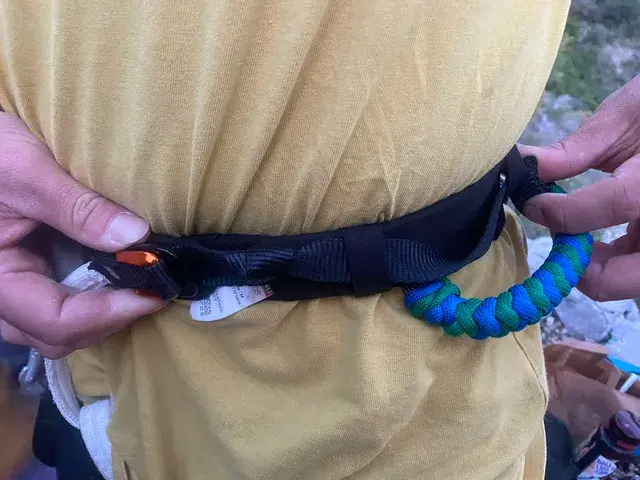
• 2021 — Mammut Ophir 3 climbing harness
Situation: failure of the quick-adjust waist buckle while climbing outdoors.
Outcome: no injuries.
Cause: metal corrosion.
Comment: according to the user, the harness was less than two years old and had been used in very hot and humid conditions (rain + sweat); signs of corrosion had been noticed beforehand, but no action was taken.
Source: reddit.com
Situation: failure of the quick-adjust waist buckle while climbing outdoors.
Outcome: no injuries.
Cause: metal corrosion.
Comment: according to the user, the harness was less than two years old and had been used in very hot and humid conditions (rain + sweat); signs of corrosion had been noticed beforehand, but no action was taken.
Source: reddit.com

• 2018 — Singing Rock “Digger” caving harness, Cedar Knob Cave, USA
Situation: leg loop failure while ascending a rope.
Outcome: no injuries.
Cause: severe localized wear.
Comment: the harness had been used for about 6 years and roughly 3,500 times; it had been inspected regularly, but the critical wear zone was partly hidden by a protective cover.
Source: caves.org
Situation: leg loop failure while ascending a rope.
Outcome: no injuries.
Cause: severe localized wear.
Comment: the harness had been used for about 6 years and roughly 3,500 times; it had been inspected regularly, but the critical wear zone was partly hidden by a protective cover.
Source: caves.org

• 2017–2018 — canyoning harnesses, France
Situation: three independent cases of harness failure under body weight.
Outcome: no serious injuries.
Cause: critical strength loss caused by intensive use in harsh canyon environments — water, abrasion, and UV exposure.
Comment: follow-up testing showed strength losses of up to 90% after 3–4 years of heavy collective use; visual condition did not always reflect residual strength.
Source: 1) theuiaa.org 2) theuiaa.org
Situation: three independent cases of harness failure under body weight.
Outcome: no serious injuries.
Cause: critical strength loss caused by intensive use in harsh canyon environments — water, abrasion, and UV exposure.
Comment: follow-up testing showed strength losses of up to 90% after 3–4 years of heavy collective use; visual condition did not always reflect residual strength.
Source: 1) theuiaa.org 2) theuiaa.org

• 2013 — Black Diamond harness, climbing gym
Situation: once the rope was weighted, the load-bearing webbing suddenly delaminated from the waist belt; the climber felt themself tipping backward, grabbed the rope, and was lowered safely to the ground.
Outcome: no injuries.
Cause: critical weakening of the textile material due to chemical exposure — most likely sulfuric or hydrochloric acid.
Comment: according to the user, the harness appeared to be in near-perfect condition, had been used for about a year exclusively indoors, and was carefully stored; the damage was not obvious: slight corrosion on the buckle and discoloration of the nylon stitching (which turned pink and, as it turned out, could be torn by hand).
Source: blackdiamondequipment.com
Situation: once the rope was weighted, the load-bearing webbing suddenly delaminated from the waist belt; the climber felt themself tipping backward, grabbed the rope, and was lowered safely to the ground.
Outcome: no injuries.
Cause: critical weakening of the textile material due to chemical exposure — most likely sulfuric or hydrochloric acid.
Comment: according to the user, the harness appeared to be in near-perfect condition, had been used for about a year exclusively indoors, and was carefully stored; the damage was not obvious: slight corrosion on the buckle and discoloration of the nylon stitching (which turned pink and, as it turned out, could be torn by hand).
Source: blackdiamondequipment.com

• 2012 — Black Diamond “Blizzard” harness, climbing gym
Situation: right leg loop failure during a standard indoor lead fall.
Outcome: the user was uninjured, left hanging in a distorted harness.
Cause: critical weakening of the material due to exposure to an unknown acid, likely sulfuric.
Comment: aside from faded areas (tie-in point and inner sides of the leg loops), the harness appeared to be in acceptable condition.
Source: thebmc.co.uk
Situation: right leg loop failure during a standard indoor lead fall.
Outcome: the user was uninjured, left hanging in a distorted harness.
Cause: critical weakening of the material due to exposure to an unknown acid, likely sulfuric.
Comment: aside from faded areas (tie-in point and inner sides of the leg loops), the harness appeared to be in acceptable condition.
Source: thebmc.co.uk

• 2006 — Todd Skinner
Situation: belay loop failure under body weight.
Outcome: fatal fall.
Cause: severe wear of the belay loop, partially hidden by the connected gear.
Comment: the case is especially notable because Skinner was one of the most experienced climbers of his time and was aware of the harness’s poor condition.
Source: americanalpineclub.org
________________________
It is important to understand that these cases represent only a small fraction of all incidents that actually occur. Some failures are never documented; others are never made public.
A significant number of incidents are also linked to manufacturing defects or design flaws. One of the most recent high-profile examples was the 2024 failure and subsequent recall of the Black Diamond “Vision” harness line: mountainproject.com. Unfortunately, cases like these offer little room for analysis — or reassurance.
Situation: belay loop failure under body weight.
Outcome: fatal fall.
Cause: severe wear of the belay loop, partially hidden by the connected gear.
Comment: the case is especially notable because Skinner was one of the most experienced climbers of his time and was aware of the harness’s poor condition.
Source: americanalpineclub.org
________________________
It is important to understand that these cases represent only a small fraction of all incidents that actually occur. Some failures are never documented; others are never made public.
A significant number of incidents are also linked to manufacturing defects or design flaws. One of the most recent high-profile examples was the 2024 failure and subsequent recall of the Black Diamond “Vision” harness line: mountainproject.com. Unfortunately, cases like these offer little room for analysis — or reassurance.

If you are aware of other cases, please feel free to contact me via Facebook, Instagram, Telegram, or at bikulov.r.a@gmail.com so they can be included in this list.
